
Larder beetle
I’m sure everybody has seen these:
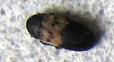
This is obviously a larder beetle, Dermestes lardarius. It is a little fellow, only about half a centimeter long or so. They get into decomposing garbage, stored foods with bad seals, and similar things[1]. Since they find our garbage so appealing, they have been carried by us pretty much around the world.
Close up, we can see that the brown patch on the back isn’t actually pigmentation in the wing covers, it is evidently a patch of short brown hairs, and the black spots in the brown region look like simply patches where the hairs are missing (although it could be black hairs, it’s hard to tell):

When flipped over, he started to flail around with his anntennae, so that you can see how they end in a clubbed structure.

I don’t have a picture of the larva, but they are a kind of bristly little grub. I think that people sometimes think that the bristles on the grubs are legs, and so describe them as something with “lots of legs”, even though they only have the normal number[2].
Larder beetles are one of the many species of dermestid beetles, a number of which are known for eating skin from long-dead corpses[3]. I’m told that a good way of extracting an intact skeleton of a dead animal is to let the dermestid beetles at the corpse, they will eat off the skin and dried flesh, but leave the bones behind, intact and nicely polished. Museums actually use them for this purpose. At the same time, museums have problems with dermestid beetles getting into their mounted specimens, and they are a big problem when they get into a traditional insect collection [4].
Note added in 2014: I now have some better pictures posted here. They show things like the head and antennae.
———
[1] I used to find them a lot in old watermelon rinds on our compost heap when I was a kid.
[2] “The normal number” being six.
[3] I don’t know whether the larder beetle is one of the species that eats skin, I’ve mostly seen them eating rotting vegetable matter. Bug Guide mentions that they are one of the species that infests museum specimens, though, so they probably do.
[4] A big part of the reason why I am doing this with photographs instead of collecting pinned specimens, is that preserving pinned specimens to keep out things like dermestid beetles is a hassle. That, and pinned specimens take up a heck of a lot more space than a few thousand digital pictures.
Comments are closed.
but I have shed skins too, is that the larder beetle ….
I had my car detailed, and the detailer said I had maggots, I want to know!
I keep finding one or two of the Larder beetles in my dirty laundry after it has been sitting there for a couple of days. I was wondering why I only find one or two, and why they are in my laundry if there isn’t anything for it to eat? I don’t find it any where else in my house only the dirty laundry. I do have small children, and a dog. I am just concerned about the dog eating one of these if she gets the chance, and the Larder beetle possibly biting my children. If you could answer any of these questions it would be very appricated. Thank you, Danielle
Danielle: They like dark places to hide, and a basket of laundry is full of nice crevices. If the laundry is even slightly moist, that might tend to attract them slightly. If it was more attractive, then probably you’d get more than one or two. There probably is something around for them to eat (they really like compost piles, for example), and if they are getting into the house from wherever they are really breeding, then the laundry would be an obvious place for them to look for a hiding place.
I don’t think it is a problem if the dog eats one, I’m pretty sure they aren’t toxic. She might like them, they are probably a bit like popcorn for a dog. They don’t bite, either, so your children are safe. A larder beetle might knaw on their fingerprint ridges a bit if they pick one up, but they aren’t going to do anything more than tickle or pinch slightly.
So do their larvae look like mini caterpillars. Fuzzy and about 1/8 to 1/4 inch long?? How do you get rid of these pests!!! They are irritating the crap out of me! I find the larvae in dark cabinets or the bathroom. The beetles have been found in the laundry room mostly! I know they are not harmful, they just piss me off! 😉
If we remove our carpets, will that eliminate these little insects?
Stephanie: Well, carpets are pretty filthy things (even carpets that are cleaned carefully have a lot of embedded dirt down where you can’t see it, and dirt filters down into the padding as well), so removing them certainly won’t hurt.
Personally, I dislike having carpets. They are a tremendous hassle to keep clean, and for not much benefit.
How cute, it’s a beetle! Look at the cute little thing! Look at the cute little beetle thing!
Am Simon from Kenya, am a business man who deals with collection and preservation of dead beetles of various species e.g fornasinius, blue Dicronrrhina, Cetonidae, cerambycidae, Buprestidae and Lucanidae among others
I would like to submit my written request for a supply of the above mentioned species of insects
thanking you in advance
Simon Muchira
i had some last year and they went away it wasnt a big deal… but now there everywhere! i find theyre nasty larvae under the couch and i vacuum and clean but u cant clean every crack and crevice especially when i have 2 kids who bring crumbs everywhere they go… they also like my laundry… can they be living in my couch… i am moving and have been packing and washing everything can they get inside my packed boxes? i dont have any pets or animal carcasses or flies i dont understand why theres so many…
Hi! I am also wondering what is the BEST way to get rid of them. I want them gone. It makes me feel gross to know there is bugs in my house. I don’t like thinking that my 11 month old can find them and maybe stick it in his mouth. Please help
Rebecca: There is a lot of discussion about how to get rid of this sort of beetle over here, on my Carpet Beetle Larva page. It basically boils down to eliminating food sources, keeping things dry, and vacuuming in crevices and under furniture.
Incidentally, if my experience with our two daughters is any indication, your son is going to eat lots of worse things than the occasional beetle over the next year or so. I’d recommend trying not to think about it too much.
i have hundreds of these little blighters! i live on the 7th floor in a flat so i dont have a clue how they have got in, but they are in evry room. like others have commented, there favorate place is my laundry basket! also i find them down the crevices of my sofa. i see more of the larvae than the beetles themselfs, im due to move soon into a house and im scared of taking any furniture with me incase they follow, creepy looking things and i cant stand them!! is there no way of completley elliminating them?
I find a few of these little bugs here or there….mostly in my laundry. It bugs me to know they are crawling around my house. I HATE bugs!! So not to sounds like a moron but does anyone know if they could crawl like up my headboard onto my bed????
Kayla: They could, but they probably won’t. They’ll mostly try to stay in warm, dark, preferably slightly moist places where there are things to eat and where nothing disturbs them.
I’m dealing with the same issue with these and they just gross me out. I’ve found them in my daughters diaper, our laundry, and I’m tired of preparing a meal and finding them in the boos and have to re-start a meal. Others have asked but you haven’t addressed it but we are looking into moving, I really don’t want these larvae to find a home in our new home. What can we do to prevent that?
Kendra:
You don’t have to worry about taking them with you when you move, because larder beetles (and carpet beetles) live outdoors as well as indoors pretty much everywhere that people live. Wherever you are moving to will already have them, or something very like them. What you need to do is make sure that they don’t want to come in. Which means keeping the area where you store food clean and dry, keeping stored food like flour in sealed containers, making sure that you don’t have moisture in your basement, and vacuuming up pet hair under furniture.
Tim,
We moved intonto our house 4 years ago. And these lottle guys were her already. I would find 25 or so during the summer months (4). Then nothing in the winter(8). It never really bothered me. However during my spring cleaning this year I cleaned under my stove. There was food under it of course. But I decided to pull my baseboards off as well bc I saw one. I found 4 adults, 5 at different stages and a bunch of skins. It is really hard to vacuum in the crevices of the floor. So I proceeded to take all our baseboards off. A few more here and there. More skins. Does it sound like a have a bad infestation. I will be more diligent with my cleaning expecially under the stove. But should I worry and do more?
Ashley:
It sounds like you have a perfectly normal number of them, in the place where I’d expect to see them. Once the food under the stove is gone, they will be pretty much gone, too. I generally regard them as not so much pests in their own right, as an indication that you need to clean up some spilled food. They aren’t potential disease carriers like flies and cockroaches, and so aren’t really a problem unless they are getting into your stored food.
I’ve been finding them in my bed which is wierd because I don’t have any food in my room… Why would they be in my bedroom??
I have seen recently two of these beetles. both were in my laundry basket. I made a trip recently and brought home a few dirty clothes. In 18 years in this house I have never seen them before. This morning I found one beetle lying on it’s back dead. The only thing I can think is that it was killed by the device I used to keep my house insect free. It plugs into the outlets and emits a piercing sound that kills even fly’s. Humans can’t hear it. The only thing it doesn’t kill is fruit fly’s. This year I bought some sticky tape to get rid of them. It also doesn’t kill ants that well. I just make sure I kill the hunter ants, the ones going out to find food and that usually fixes it.
I was recently cleaning my bedroom and found about four (one was dead) of these beetles underneath some clothes I was sorting through. I haven’t seen any larvae and there is no food on this floor of the house (my room is in the basement), pet or human. How and why are they in my room, – I have not seen them anywhere else in my house – what are they eating, do you think there are more, and how do I get rid of them? Thank you!
I have seen several larder beetles in my bathroom and I’m wondering why? Have also seen them in the cupboard where my pots & pans are kept,as well as in my kitchen drawer where I keep my clean dish clothes. Please help me understand why I see them in these places.
Why do i keep finding Larder bugs in my bed? I have a temperpedic, do i need to get rid of my bed? Or do i just need to change my sheeta more often? Someone help?! The only place i find them is in my bed and im incredibly uncomfortable with that…