
Camel Cricket
While cleaning up some stuff in the basement, out of the corner of my eye I spotted something bounding up in the air. And by “bounding”, I mean getting up about two feet off the floor. So I went to investigate, and found this:
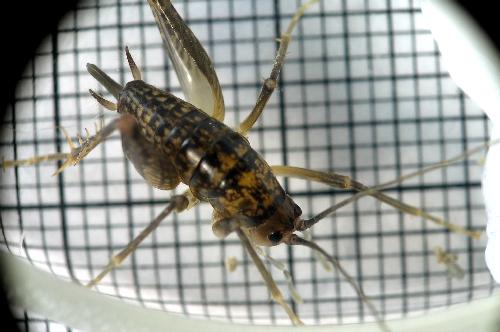
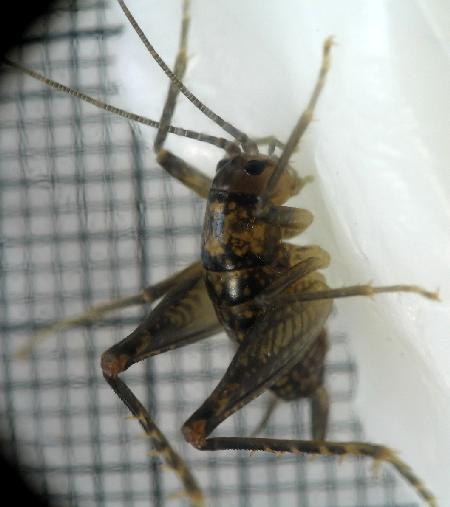
OK, so this is clearly something in the order Orthoptera – grasshoppers, katydids and crickets. Here’s an opportunity to use this great book that I just got a few weeks ago: The Orthoptera of Michigan[1]. It only took a minute or two to sort out that it’s a “Camel Cricket”, genus Ceuthophilus. The winglessness, humped back, long legs, and very long antennae made it pretty easy to make the match.
The antennae are very long, I had to take a long shot in order to get them all in. I’d say they are easily twice the length of the body:
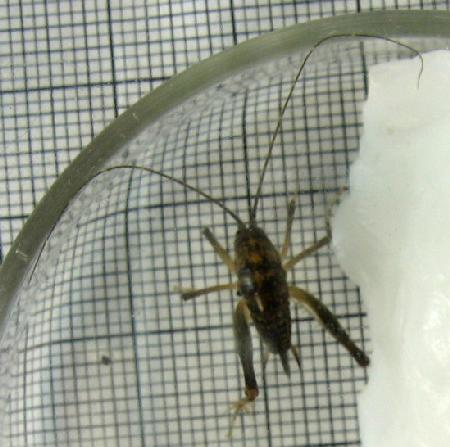
It looks to have an ovipositor, so I’d say it is most likely a female. It looks like the males have significantly shorter abdomens in most species. She’s got some pretty pronounced spines on the hind legs, too, which look like they’d be a problem for anything that wanted to eat her[2]:

So, anyway, this isn’t the type of cricket we usually see, normally we get the jet-black field crickets that chirp by rubbing their wings together. This one has no wings, so obviously isn’t going to do much chirping. The long legs seem to help it jump a long way (it could jump almost 2 feet in the air), but it seemed to have a long cycle time between jumps, so it was relatively easy to catch it. In comparison, the comparatively short-legged field crickets only jump a few inches at a time, but they can jump every second or so, which actually makes them a bit harder for me to catch.
Camel crickets eat pretty much anything organic they find, and like to hang out in protected places like the undersides of logs, under rocks, leaf litter, caves, and (obviously) basements. They like a bit of moisture, so they do well in a somewhat damp environment, and they evidently like things a bit on the cool side.
Orthoptera of Michigan gives a few methods for catching crickets on purpose, as opposed to just grabbing them as the opportunity arises: (1) leave a small pile of dry oatmeal in the woods to attract foragers, and check on it very early in the morning; (2) find a bare spot on the ground, and prop up a board over it so that crickets looking for a hideout will crawl under it; (3) make a pitfall trap from a cup buried up to its top in the ground, with molasses in the bottom for bait; and (4) smear treetrunks with molasses. It sounds like these methods will probably attract quite a variety of small crawling things, not just crickets. I need to try a few of them this summer.
————
[1] By Roger G. Bland, Published in 2003 by Michigan State University, Extension Bulletin E-2815. It has color photographs and everything, along with full-blown identification keys. I love these guides that are specific to the region where I am – the region-specificity really weeds out a lot of extraneous possibilities, allowing me to focus right in on the relevant stuff. Most insect guides for North America seem to have about 90% of their entries consisting of things from Florida, Texas, or California that wouldn’t be caught dead this far north. The MSU Cooperative Exension Service has a lot of really good local guides: I have the ones for butterflies, grasshoppers, snakes, turtles, amphibians, and Insects of the Great Lakes Region.
[2] “Do not try to eat the large grasshopper legs, as they have barbs that may stick in your throat.” (from the U.S. Army Survival Manual, FM 21-76, page 1 of chapter 7, “Wildlife for Food”). Sounds like good advice to me!
Comments are closed.
My wife HATES these things. Hates them with the hatred of a thousand suns. As a result the family she stayed with in High School froze one and put it on her pillow. Hillarity ensued.
That first picture put me in mind of the “head crabs” from the games Half-Life and its later iterations for some reason.
Very cool pictures.
I find these “things” on my porch with a concrete floor that has a gap in it to the ground. I hate these “things” mainly because they are so ugly but they also startle me when they jump. They seem to be easy to kill with bug spray but always return later. How do I get rid of them permanently? They seem to have appeared only a couple of years ago.
Well, as far as getting rid of them permanently, I think you’ll need to either eliminate the conditions that attract them, or close off the route that they are using to get in. If you can close up that “gap” in your concrete floor, that’s probably how they are getting in (assuming they are not breeding under some object on your porch, in which case they aren’t “getting in” at all).
If you can reduce the humidity, that will probably help too. They need a food source, so if there is anything like rotting wood or mildew about, cleaning that up will probably encourage them to move along instead of hanging around.
Alternatively, you could introduce a predator. Tarantulas love them 🙂
I found one in my bathtub last night and “mildly” freaked out. I figured it was some kind of cricket, but I have never seen one like this before.
I hate those things! And if you try to kill them, they will go after you! It is a good thing that I don’t see a lot of them because my cat takes care of them. Every time I see one in my room, I get my cat and he will go after it and eat it. But those things don’t die very easily. One minute, you would think it is dead and once you turn your head of blink, they are gone. You can take away all its legs and it will still be alive. Those things scare me.
They don’t “go after you” – they just jump towards you. They’re completely harmless but totally disgusting.
I was in the shower and one of them jumped towards me, I freaked and jumped back kicking my heal into the tub faucet, it took weeks for my inury to heal. I didn’t know what they were until tonight. We always called them scary Gratis bugs. Since the first time I saw one that’s where I lived lol!
We call them “hopping things.” I just saw one, first time this summer since last summer and its body looked different. Could it have mated with something. It had the body of a stink bug. I am very alarmed.
Ann: Do you have a picture? Did it look like it had wings? There are some kinds of crickets where the wings lie flat in a kind of stink-bug-like way (like tree crickets). I think there are also some true bugs that have long jumping legs, like some of the damsel bugs, plant bugs, and assassin bugs. In any case, you don’t have to worry about camel crickets cross-breeding with, say, stink bugs. They are quite distantly related, and that would be approximately equivalent to a seagull cross-breeding with a fish.
i moved to my new apartment yesterday… just opened a closet now to find three of them!!! they scared the crap outta me because i instantly thought SPIDERS!!!! and then i saw the antennae. and then they started jumping. and i realized they must be crickets of some sort… i looked around the closet (and by looked around, i mean sheepishly took some pix with my camera) and i don’t see how they got in there or where they’re breeding. in the meantime, i’ll be leaving that door open and leaving them to the mercy of my kittens….!!
These guys are new to me. I found one th eother night…only half a leg and a little body were showing from under the baseboard heater in my bathroom. I freaked out because I just moved to New Jersey and I have no clue what to expect. I thought it might hab=ve been a spider until my daughter said she saw a huge cricket in the bathroom. Then last night I walked in and there he was, but since I had it in my head that it was a spider we tried to get it, but it git away. Now I have an exterminator coming because this old house holds more then crickets. Creeps me out!!
I have not seen a camel cricket in a while. So i was surprised when i got to work this morning and on my desk..the guys i work with had put one there in a cup 🙂 yeah they think they found a “mutant cricket” so i had to school them on what it actually is. BOYS???!!! 🙂
We have a lot of these in our basement, and they seem to be attracted to my cat’s litter box. Every now and then, there’s a piece of poop outside the box, and the camel crickets always seem to be swarming over it. I’ve read where they will eat most organic things – could they possibly be feasting on my cat’s poop?
Renee: They certainly could! Carnivores like cats don’t have very efficient digestive systems, so there is still a lot of food value left in their poop. And when we raise feeder crickets, ground-up cat food is one of the recommended things to feed them.
The crickets probably think it is the Greatest Food In The World.
I live in a mobile home and these creatures are only seen in the colder months. I get freaked out when I see them. Our name for them was Spidercrickets..lol
Thank you for this information. Will be passing it on to my sister who has them also…
I THINK I just saw one of these and tried to kill it with the first thing I could grab, which happened to be a sponge mop. No matter how hard I hit it, it wouldn’t die. Now I’m not sure where it is…somewhere in my bedroom…which is why it’s 12:53am and I’m not in bed yet. Ugh!
I know there are some bug lovers on this site and what I am about to say might offend you. However, I did read a comment that asks how to get rid of them. First thing I did was stalk it and scare myself and my teenage daughter in the process. I had no clue what it was and the one I was chasing was a full grown big guy. He looked like a crazy spider; especially considering I wasn’t wearing my glasses. LOL…
Anyway, I did what and person terrified of creepy crawlers does…I called terminex. 🙂 They came out and sprayed my basement and around my house. The gentelman also left a sugar glazed sticky pad in my bathroom where I spotted the first one. Within four days the sticky pad had 5 camel crickets ranging in size and I haven’t seen one in my house since. It has been over a year now. Terminex comes out quarterly and it is worth the 65 buckes every four months.
Like I said, I know some of you love these guys….but I can’t do it. I respect mother nature and all…but not in my house. Call me a city girl…I don;t mind…but I just cant get past it. The irony is not lost on me either….so small and yet so terrifying.
Cheers.