Giant Water Bug – Toe Biter

2009 May 30

[Scene: my office, afternoon of May 21. The phone rings]
Me: Hello?
Sam: Dad! Mom caught a GIANT WATER BUG! She tried to pick it up, and it GRABBED her! She shook it off, and caught it in a DIAPER! We put it in a jar! It’s GIANT!
Me: Wow!
Sam: Well, OK. Bye! [click, hummmmmm][1]

Sam and her bug in a jar

Sam and her bug in a jar

A minute later S_ called back to give the details, and Sam had the story substantially correct. They had just pulled out of the grocery store parking lot, when S_ saw what she thought at first was a small bird fly by, until it landed on the road [2] in a very un-birdlike way and she realized it was a very large insect. So she jumped out of the car[3], and caught it pretty much the way Sam described. Then she drove home with the diaper-wrapped[4] bug in one hand, feeling it squirm around forcefully from time to time. Once they got home, she popped it into a mason jar with a screen lid, and that’s about the time that Sam called me.

giantwaterbugdorsal

Sam wanted to keep it as a pet, so once I got home, I took Sam to Wal-Mart and picked up a small 1-gallon aquarium kit. We also picked up a feeder goldfish. Then we set up the tank, made sure the lid was on and the aerator was working, put in the water bug and the goldfish, and watched.
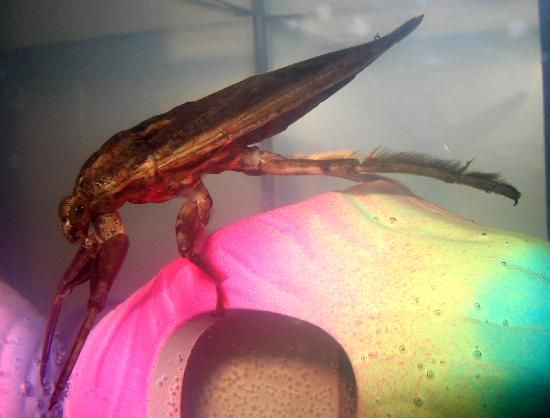
giantwaterbugside

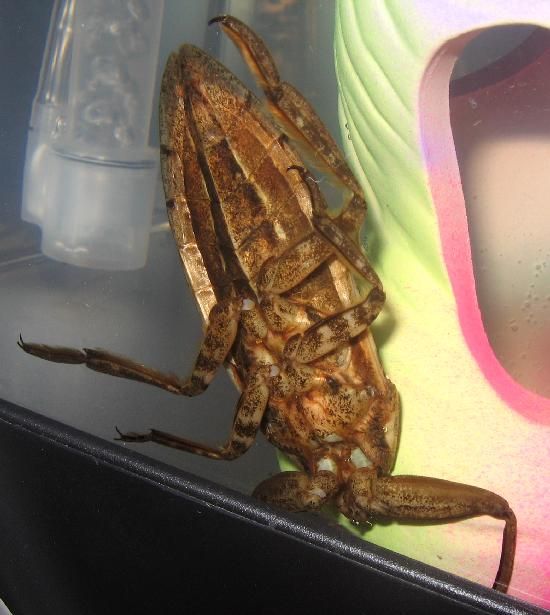
giantwaterbugventral

Nothing much happened for a long time, other than the fish swimming around and the bug periodically moving from one perch to another, and finally we went to bed.

The next morning around 5:00, I heard Sam yelling from her room, so I went to see what was wrong. At first I thought she’d been scared by a bad dream, but then I realized that . . . something . . . was making a scrabbling noise from her yellow toy bin. So I went over to look, and . . . there it was. The giant water bug was in the bottom of the bin, scrabbling to try and get out. The thing is, Sam’s room is at the extreme other end of the house from where the aquarium is, so the bug had to get out of the aquarium (by squeezing through the opening in the lid that the aerator tube passed through), then fly the entire length of the house, then crawl under Sam’s door (which was closed), and then fly again to fall into the toy bin. It’s easy enough to see how it did it, but the why is another question.

Anyway, I got it back into the aquarium easily enough, and put a largeish rock on the lid to keep the bug from getting out again[5]. Later that morning after I’d gone to work, the bug finally took an interest in the goldfish, and ate it. S_ got some good pictures of the event. She says that the bug first bit the fish in the eye, which I expect dissolved its brain[6] and killed the fish almost instantly.
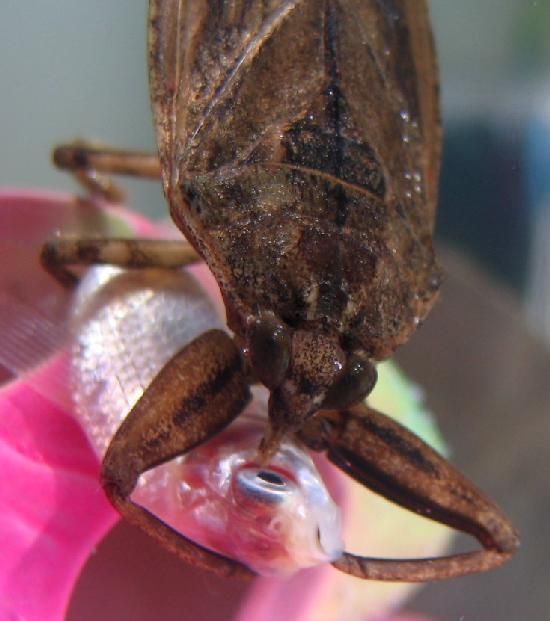
giantwaterbugeatinggoldfish2

Then it settled down to inject digestive fluids into the fish body proper and suck out its insides. S_ says that it would stab a spot, suck for a while, then move to another spot and start again while the fish gradually deflated.

giantwaterbugeatinggoldfish

So. This is clearly a giant water bug. Given the size (about three inches long), it is most likely one of the six species in the genus Lethocerus. I think it’s either the regular American Toe-Biter Lethocerus americanus, or maybe the Eastern Toe-Biter, Lethocerus griseus. There’s supposed to be a groove in the front femur of Lethocerus americanus that is characteristic of the species, but I can’t quite tell if it is there or not. Giant water bugs are among the largest insects in North America, and reportedly quite tasty (the ones in Asia are even bigger, and are often eaten). The ones in North America live for about two years, starting out as small nymphs that prey on other small arthropods, but eventually graduating to eating minnows by they time they reach adulthood. They overwinter as adults (which is why this one turned up so early in the year), and lay their eggs in the spring and summer. In some species, the females lay their eggs on the back of the male, and he looks after them until they hatch, but other species lay their eggs on weeds in the water.

The giant water bugs do not breathe water, they trap an air bubble under their wings and breathe from that. Periodically, they will refresh their air supply by poking the tip of the abdomen through the surface, pushing out the stale air, and pulling in fresh air, like it is doing here:
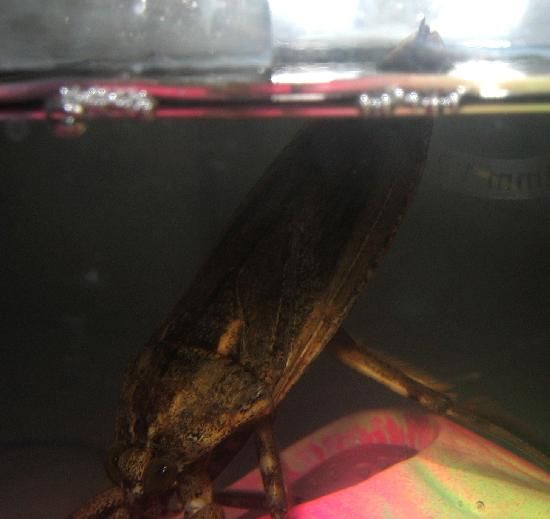
giantwaterbugbreathing

That air bubble makes them very buoyant. Ours has to either swim hard, or hang onto something to stay submerged, otherwise it pops right to the surface. Once it gets out of the water, the skin is so water-repellent that the water beads up and runs off immediately. They fly pretty strongly, and given how we found this one, they are obviously pretty mobile – the nearest body of water substantial enough to support appropriate prey for a giant water bug was about a half-mile away from where it was found.

They make pretty cool pets, but I’m not so sure I would say they are good pets. Keeping it in goldfish is a bit more expensive than keeping a spider supplied with flies and crickets, and they are really prone to escaping if there is any opening in the lid of the aquarium that they are kept in. And the way that they get around the house once they escape, combined with the potential for a very painful bite if you, say, step on one, suggests that maybe other arthropods are a better choice for a pet.

UPDATE: I was given a dead (but fully intact) giant water bug to photograph in March 2012, and here are some more-detailed pictures of particular parts of its body that we didn’t get a good view of with the live one.

—-
[1] Phone conversations with a 3-year-old can be a bit abrupt.

[2] We have the ideal conditions for road mirages right now (pavement heating in the sun with cooler air), so it often looks like the pavement is covered with water. S_ thinks that the bug mistook a road mirage for a small pond, and tried to land in it.

[3] Interestingly, nobody in the cars stopped behind her blew their horn at her or anything. I expect they were probably sitting there watching, and wondering “what on earth is going on there?”

[4] Yes, it was a clean, unused diaper. It was for Sam’s younger sister, incidentally.

[5] At the time, I thought that it had pushed the lid up and squeezed through, so the rock seemed like a good idea. But then, it got out again the next night, so I checked more carefully and found that the hole in the lid was wider, and the bug was narrower, than I had thought. So, we covered the hole in the lid with tape, and now the bug stays inside at night (although it still crawls up and claws at the lid when it gets dark).

[6] Like assassin bugs, giant water bugs inject digestive fluids into their prey to liquefy the insides, and then suck up the resulting slurry. Their bite is reputed to be extremely painful. Not so much because it is an actual venom[7], but because it is dissolving your flesh. This one later ate a second goldfish, and did the same thing – stab through the eye first, then go to the body proper. So, it looks like biting the eye first is no accident, but is a behavior evolved specifically to kill the fish as quickly as possible.

[7] Venoms, like bee venom, often have compounds that specifically cause pain by activating your nerve endings, but a lot of venoms don’t actually cause all that much gross physical damage to your tissues. Giant water bug bites are not like that at all. They are more like an internal acid burn.

80 Responses leave one →
  1. Jennifer Gard permalink
    November 4, 2010

    As an avid hobby naturalist, I knew these were around but had never seen one in person. One of my coworkers just brought in a dead one for me to ID (I always get the weird critter questions). I found this site looking for pictures to show to prove I’d ID’d it correctly. What fun! My son also gets excited about bugs, and will love to “collect” this one. Too bad it’s not alive, it would have been interesting to have around for a while. Lucky Sam to get to experience that, and to have parents with the knowledge and interest to share these things with her.

  2. Sharon permalink
    November 4, 2010

    I saw some of these at the Washington National Zoo on a field trip with my 2nd grader yesterday. They were so predatorily scary-looking, but still facinating–I had to google them, and that’s how I found your awesome blog.

  3. Emma permalink
    January 25, 2011

    wow, this is awesome. I have just been writing an article with this species featured. Im glad to see such useful images to compare their size to other species.

    Thank you :)

  4. mink permalink
    February 2, 2011

    i got bit by this giant water bug last night, he was lying on the ground out side shoppingb centre, i love all insects, so i wasn’t hesitate to pick him up..and didn’t know that it could bite..Result? i felt like i just got bit by 100s bull ants, burning sensation but slightly gone away with in an hour..Yes i’m still alive!..

    So i will have to be more careful next time…

  5. Kate permalink
    May 7, 2011

    I’m glad I found your website. I discovered a giant water bug in my hallway, missing a leg. One of the cats probably brought it in. I live in Reedsburg, WI near the Wisconsin Dells. I was able to ID it through the University of Wisconsin Entomolgy Dept. website and then I googled “giant water bug” and found your site.

    You have inspired me to put the creature in the aquarium, although I am ambivalent about sacrificing the goldfish. I only set up the tank a week ago. As you said, the bug frequently sticks its rear end into the air, and sometimes releases large bubbles. It really scrambles to stay under water.

    Thanks for sharing your experience. It was helpful.

  6. May 7, 2011

    Kate: Glad to be helpful. It occurs to me that the Giant Water Bug probably doesn’t have to specifically eat fish, they will most likely take any live meat of appropriate size. You could try dangling an earthworm in front of it, for example. If it takes worms, then that would be a lot more convenient all around than goldfish.

  7. BugBarb permalink
    June 6, 2011

    I volunteer at a local park’s nature center and set up displays of live bugs every weekend. One day, while at the stream gathering more live stream gunk for the aquarium, I saw a daddy toe-biter with about 60 eggs on his back. It has been fascinating watching them hatch and grow. I put in molly babies for them to eat, but they won’t touch them. When I’m not feeding them large termites, pill bugs or earthworms, they thrive on a diet of pond snails. The species I found is about 2 inches long when fully grown.

  8. Leslie permalink
    June 23, 2011

    OMG! I found one in my pool. I don’t like bugs anyway, and I drowned it, then stepped on it for good measure. Now I know they bite painfully…and I have four kids…!!!! Crapola!!

  9. Christina permalink
    July 21, 2011

    I think I just found these in my pool
    But we can’t get rid of them any ideas?
    We shocked it and put algaecide (just in case) since they
    Feed off of any algae right? Nothing has worked
    PLEASE HELP!!!! It’s so hot here and my kids
    Can’t go in the pool because of these stupid bugs

  10. July 21, 2011

    Christina: The Giant Water Bugs are huge – up to several inches long. If you have these in a pool, you should be able to catch any dangerously large ones with a net, no problem. They fly, so if you are leaving a yard light on around your pool it will likely attract them. If there is such a light, turn it off and I expect you will stop seeing the bugs. Once in a chlorinated pool, they shouldn’t survive very long – toxic environment plus no food should kill them within hours in any case.

    The water bugs that eat algae are much smaller, and completely harmless. I wouldn’t worry about them.

  11. Christine M permalink
    July 26, 2011

    Your giant water bug story lives on! I too found one in Minnesota today (on a sidewalk, near a swamp, during my morning walk). Although I can’t say I share your enthusiasm for such a creature, I was fascinated by it nonetheless and snapped a photo on my camera. One fb posting later, and my friends had it id’d ten minutes later as a giant water bug. Glad I didn’t try to touch it or move it off the sidewalk. Yikes!

    Thanks for the info. All hail the giant water bugs!

  12. Creeped Out permalink
    August 11, 2011

    We found one today in Wood bridge ON (out skirts of Toronto) directly across the street from a produce shipping center. and we found your website/post and put him in a water bottle and he seems happy we will try and find a good home for him but i don’t know 2 many people that want to give a big scary Bug a home. Ty for your post it was very helpful. Bye the way they eat these things in Thailand.

  13. BugBarb permalink
    August 12, 2011

    I have a “daddy toe-biter” in my 55 gallon aquarium. The female at the Nature Center where I volunteer apparently had enough eggs to cover the backs of TWO males! I took one male home to keep my snail population down. They are great at controlling those pests. I sure noticed a rise in the snail population when my last one ran away. Oh yes, that brings me to one very important thing you must do if you keep one in an aquarium. You must seal up every exit, as they will decide to leave. You never know when. One day, you will look in the tank and,….no bugs! I feed my adult bug a large cricket every few days. Sometimes they will attack and impale the cricket. Other times, I skewer the cricket on the end of a bamboo skewer. Then, I slowly approach the bug, waving the cricket back and forth until he attacks and gets a good hold on the cricket. The tricky part is pulling the skewer out, letting the bug eat in peace. I think they make great pets.

  14. Raptorclaw permalink
    August 20, 2011

    Ive been trying to find one for the past two years and haven’t seen one yet! I need some pointers. You people are lucky to find one. Is there something wrong with where I live that I can’t find one? Because I’m pretty sure that giant waterbugs live in north carolina.

  15. August 21, 2011

    Raptorclaw: I’ve only ever seen three giant water bugs in my life, and all of them were found on sidewalks or roads in populated areas. The first two were found in the morning near streetlights in the general vicinity of a good-sized lake, and the third was the one in this posting. This suggests that “blacklighting” near a large body of water in the spring or fall would be one way to catch one.

    Given how much they look like dead leaves while in the water, I expect that it isn’t practical to find them by hunting for them in streams or lakes, unless you are also willing to skim around in a lot of water weeds with a net.

  16. BugBarb permalink
    August 23, 2011

    I’m a “bug-god-mommy!” My daddy toe biter died and I put his eggs on a damp piece of filter poly in a tiny box. My husband and I went out shopping, When we came back a few hours later, I noticed a black spot in the box. A baby hatched! I could see another one trying to wriggle free of the egg. What a thrill! I got out my camera and took pictures of the last of them hatching.

  17. August 25, 2011

    BugBarb: Very cool! I didn’t know that the male water bugs would die before the eggs on their backs hatched. I wonder if this is normal, or if yours was unusual?

  18. Kai permalink
    August 25, 2011

    I was swimming in the pool today and looked down and one was attached to me. Ew! I flung it off in the pool and it started to swim right for me. Aggressive thing. I scooped it out and it came right back in the pool and was trying to attack me again. So after chasing it a bit to try to rescue it out, it wound up in the filter. Hey, I tried. Interesting bug though. Florida seems to have a lot of interesting bugs.

  19. BugBarb permalink
    August 26, 2011

    Tim, I have had daddy toe-biters several times and all hatchings went off without a hitch. This is definitely abnormal as I have watched him/them fastidiously aerate the eggs by sticking them out of the water and sort of pumping the butt up and down. If I hadn’t scooped him off of the bottom of the aquarium, the eggs would have died from suffocation or been eaten by my bright orange crawdads.

    I have some great video of the eggs hatching. I would post it online, you tube or something, but I can’t. I have satellite internet and we can afford only the basic package. We are limited as to how much data we can transmit and receive. If we paid more, I could probably do it. I’m going to have to find a place, a friend…etc where I can upload my videos. My camera is supposed to be able to upload directly to you tube. I’ll let you know if I find a way to upload it.

  20. John permalink
    September 22, 2011

    I would scream bloody murder if one of these things came close to me, and I consider myself to be a manly guy! One of these latched onto my friends nose one night as it was flying through the air! Sick bugs.

  21. Sara permalink
    September 23, 2011

    Hi Tim,

    Thank you for your very informative post on the giant water bug. I work in Alberta, Canada as a wetlands educator, and we have had students catch this little beast in different wetlands across central and southern parts of the province. You can imagine the chorus of screams that erupt when a group of 9-year olds see this enormous bug trying to crawl out of their dip net!

    Interestingly, all of the wetlands where we have encountered this bug were: 1) constructed wetlands, 2) stocked with fish, and 3) never observed in the spring, only in the fall. I’m unsure if there is any connection between the presence of the giant water bug and these wetland characteristics. My best guess is they are migrating to the constructed wetlands in the fall because they are deeper than nearby natural wetlands and offer a better chance of successful overwintering.

    Cheers,
    Sara

  22. September 24, 2011

    Cool hunters. I wouldn’t want to get stung by that thing. I just finished a post on creatures of southeast asia.

    http://calimike.wordpress.com/2011/09/24/three-creatures-of-southeast-asia/

    Check out the Emerald Cockroach Wasp (#3) on my post and let me know what you think.

    Best,
    Mike

  23. Bruce permalink
    September 29, 2011

    Sara, just as a follow up to your post about constructed wetlands..
    I constructed a small pond on our rural property near Creston, B.C. this summer. I cracked a drainage pipe running about 3 feet under ground and ended up digging a pond which is about 30′ by 30′ and 3 feet deep. Today I noticed one of the goldfish floating in the water with 3 giant water bugs attached to it. As someone earlier had described, one of the eyes was missing and the
    three bugs were all feeding off of it. How do we get rid of these things and what kind of density would they build up in a pond if left unchecked.
    Bruce

  24. Dave permalink
    October 8, 2011

    Just had one of these drop next to me at a gas station in Fremont, WI. Brought it home to share with my girlfriend…she was not a fan.

  25. October 29, 2011

    why did the giant water bug eat the poor gold fish

  26. British columbia. permalink
    December 19, 2011

    their instinct.they even eat little ducks and small snakes in the wild.It sometimes bite human,and it could be painful,so if you want to catch that one,you must be very careful.

  27. bety permalink
    January 24, 2012

    recently went fishing in a mountain stream with a small rubber lure, when I pulled the line up there was a large toe biter on my lure, I looked closely and noticed that his sucker thing was imbedded in the lure, it was very strange. I went fishing and ended up catching a bug!

  28. January 25, 2012

    Bety: That’s pretty cool! I wonder how much of a freak occurrence that was? It would be really amusing if it turned out that a rubber worm with no hook could reliably catch giant water bugs.

  29. March 27, 2012

    Thanks for this article! Found one of these {dead, thank goodness} in the parking lot yesterday and my cousin told me to look it up! I have three boys who LOVE to catch bugs and watch/study them so they were bummed he was already gone :( . I’ve just never seen anything so HUGE and in our area! Good information!

  30. shannon permalink
    May 12, 2012

    I live i saginaw michigan and found a live one one the sidewalk at work! I was creeped out and amazed at the same time.. are they common in these areas? Ive never seen one before now.

Leave a Reply

Note: You can use basic XHTML in your comments. Your email address will never be published.

Subscribe to this comment feed via RSS