
Small bugs from Christmas tree
On December 5, we got a Christmas tree. Sam picked out a Balsam Fir, which we brought home and set up, with no particular problems[1]. But then, on December 22, S_ found a few dozen of these little guys suddenly appearing in the house. Coincidence? I think not.

I thought maybe it was another barklouse at first. But, having been burned a bunch of times before with trying to identify very tiny insects, I figured it would be advisable to check with someone more expert. Once again, v belov, who has helped me out with a number of other small, obscure insects on BugGuide, quickly came through with an ID. It’s a Jumping Plant Louse[2], family Psyllidae. These are not aphids, although they are in the same suborder of insects that suck plant juices.
This next picture is another individual, that we found suspended in midair right about eye level. It was on the end of a strand of spider silk. There was no sign of a spider, so I’m not quite sure what was up with that.
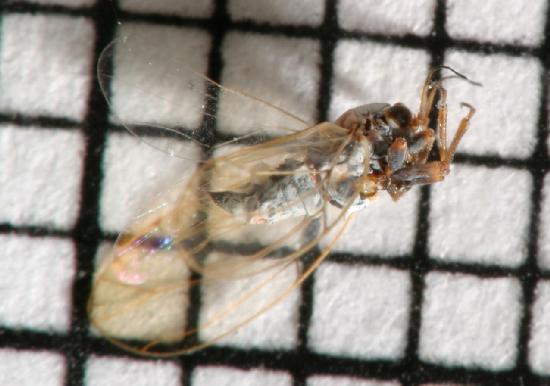
I think that these guys have some resemblance to the related Cicadas, aside from the minor detail that cicadas are a couple of inches long while these guys were practically microscopic (a hair over two millimeters long).
Psyllids like these tend to be very host-specific, so they are unlikely to transfer to parasitizing our houseplants (which is something of a relief). I haven’t been able to find anything specific about these, even given the knowledge that they were on a balsam fir, which suggests that they aren’t serious pests of this tree [3].
A lot of psyllids are gall-formers, which means that their nymphs create a small gall (basically a tumor) in the plant, and live protected inside of that gall while sucking plant juices. A lot of gall-formers overwinter inside their galls and then emerge in the spring. So, there is a good chance that what happened was this: The tree had a mild infestation of psyllids, which were all set to overwinter, when we suddenly brought the tree inside of our nice warm house. The prolonged warmth convinced them it was spring, so after a couple of weeks they finally matured and emerged from the gall – only to find themselves trapped in a house with nowhere to go. And that was it for them. Bringing wood into a house in the winter is a common way to pick up insect infestations, firewood is notorious for this.
In general, the sorts of things that hatch out from Christmas trees aren’t going to infest your house long-term, because your house isn’t much like the christmas-tree-farm habitat that they came from[4]. So, they will tend to die off after a few days, and it probably isn’t anything that you need to worry about overmuch.
———–
[1] Well, aside from the fact that we had to give up on putting on any ornaments lower than about 4 feet, due to little Rosemary wanting to pull down any sparkly things she can reach. We’ve been referring to this height as the “Rosie Line”.
[2] Not to be confused with Bark Lice, Chewing Lice, Sucking Lice, Woodlice, or Water Lice, all of which are unrelated (woodlice and water lice aren’t even insects, for crying out loud).
Lice. Don’t talk to me about lice.
[3] Searching for pests of balsam fir, I found quite a number of sites talking about things like adelgids, a certain type of gall midge, and several other diseases, but nothing that looks like these. If they caused economically-significant damage to what is one of the more popular species of christmas trees, I’m sure something would have come up.
[4] That doesn’t mean that you can’t be in for some excitement, though – if there is a praying mantis egg-case in the tree you could end up with a few hundred tiny little mantises running all over the house for some days, perching on things and looking at you with their tiny little eyes. Darn. Now *I* want a praying mantis egg-case in *my* christmas tree. . .
Comments are closed.
The bugs in my Nordman christmas tree are small black soft bodied with six legs and anntenne when squashed its black blood type liquid, have hoovered them of off the top part of the trunk of the tree, cant see any down the bottom, anyone have a name for them other than !!!!!!
Jill: There are thousands of different species of insects that meet the “small, black” description. Just go to http://bugguide.net and type “small black” into the “search” box in the upper right corner, and you’ll see what I mean. You could try browsing around there to see if anything catches your eye as looking similar.
Did you notice any other features? For example, do they have wings? What do their mouthparts look like? What is their head shaped like? Is their mouth an elongated sucking straw, or jaws? Anythng else that struck you about them?
I have the same problem with my Frazer Fir! I noticed the water was getting slimey and fishey smelling. When I stuck my finger down in the water to check the level, I came back with two, black soft bodied bugs on me. The look the world like an aphid, but black and really large for an aphid! I am used to Soybean or Peach Aphids. I know they get darker in color as the temps get colder, but these guys are in my house. So they should be green, right? I don’t think they will hurt anything, but I just wish my water was not fishey smelling.
I have to admit that this finding them in the tree’s water is puzzling. Are they dead, or are they living in the water?
If they are dead or drowning, they could be Adelgids (see http://bugguide.net/node/view/82976). Adelgids are related to aphids, commonly live on evergreen trees, and overwinter as adults. They may have been hibernating in crevices in the bark near the base of the trunk, and woke up and drowned when the tree trunk was put into a pot of water.
If they are alive and act like they are living in the water, then I don’t really have any good guesses. Is there any chance of getting a picture, even a blurry one?