
Bumblebee Mimic Fly
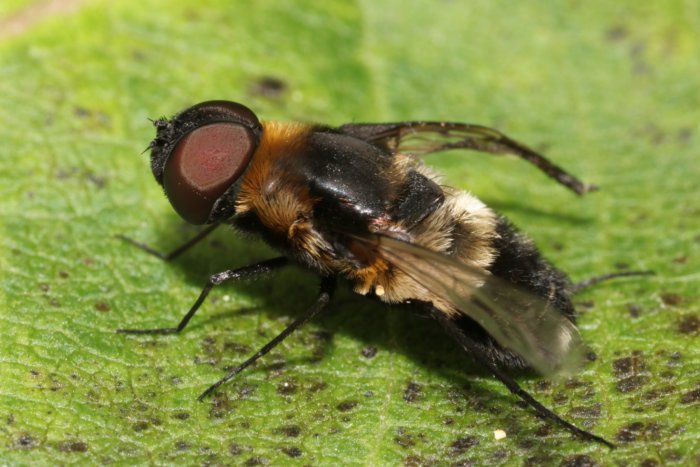
I found this big-headed fly on August 7, 2025. He resembles a bumblebee in his fuzziness and coloration, but he clearly has a fly-type head. He also only has one pair of wings like a fly, and not two pairs of wings like a bee would have.

I was able to catch him because he had a malformed wing, and so couldn’t fly. This sometimes happens to insects when they emerge from their pupal casing, and for some reason the tubes and veins that provide support for the wing don’t inflate properly. This could be because there was some sort of blockage in the veins, or it could be because the insect tried to inflate its wings in a constrained space and it didn’t have room to deploy properly in time it took to harden.
The enormous, almost spherical compound eyes mean that he is most likely a male. Male flies frequently have much larger eyes than the females, because they primarily seek out mates by sight. This one’s tiny little antennae are clearly going to be much less useful to him than his big googly eyes.


He looks a lot like Villa hypomelas in coloration, including the yellow patches under the wings and the two white spots at the tip of the abdomen.

The pattern of wing veins checks out, too.

These are one of the 800+ species of “Bee Flies” in the family Bombyliidae. These all have larvae that are parasitoids of other insects, and the adults mimic bees to discourage predators, even though these flies do not actually have any ability to sting. To the extent that the adults feed, they feed on flower nectar, which also helps in making their bee disguise more convincing. I am not sure whether the males even feed as adults, this one certainly doesn’t look like it has much in the way of mouthparts. The females lay their eggs in depressions on the ground where there are likely to be ground-nesting insects, and the larvae then burrow in and parasitize the other insect larvae that they find down there.
They are probably of some value as pollinators, but considering that the things that they parasitize are likely to be larvae of actual bees, it seems likely that they are something of a wash as far as the flowers are concerned.