
Multicolored Asian Lady Beetle Larva
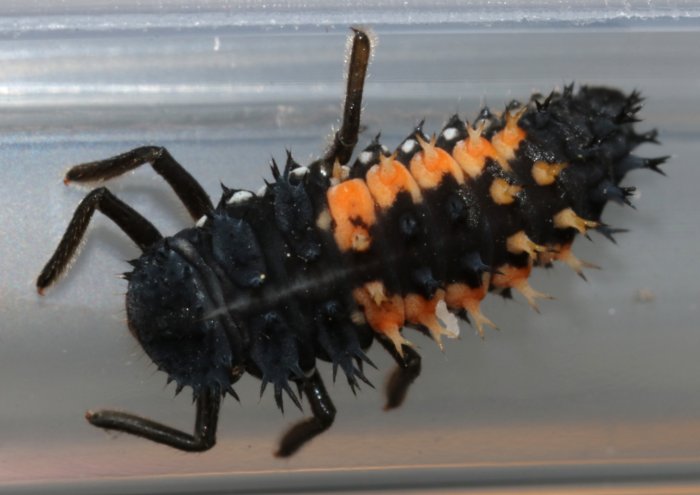
I found this colorful, spiky little feller in my office at work on August 22, 2025. This is obviously a lady beetle larva, they are very distinctive. Specifically, it is the larva of the Multicolored Asian Lady Beetle, Harmonia axyridis

While this is a carnivorous larva, it doesn’t have particularly pronounced mouthparts – no giant mandibles or anything. I think this is because its preferred prey is aphids, which are soft, squishy, and slow-moving. Things that prey on aphids therefore don’t need much in the way of offensive weaponry. They just need to shrug off the defensive chemicals that aphids are likely to spray them with.
The feet are kind of minimal. Normally insects have reasonably complex feet with multiple claws and joints and pads and what-not. But this one just seems to have a single solitary claw on the end of each leg[1].

It also has a lot of protrusions all over its body. One of the hazards of feeding on aphids, is aphids are often tended by ants. I expect that the little spines are intended mainly to fend off attacking ants until they lose interest.

So, anyway, these are another invasive species, that have gone quite a long way along the route of integrating themselves into our local ecosystem. I originally posted these way back in 2008, and had pictures of a smaller, younger specimen in 2017 (that one had a smaller head and was overall thinner). There was a big population explosion in 2008, and a somewhat smaller population boom in 2017. If the trend of a population boom every 9 years holds, then this year (2025) is likely to be leading into another burst of them next year.
Unlike a lot of invasive species, these lady beetles were actually introduced to the US multiple times with the idea of using them for pest control. It took several tries before they “took”. And now, while they do actually help in keeping aphids down on crops, the general feeling seems to be that this was a mistake, because they are as likely to eat other aphid predators as they are to eat aphids. Plus, they have a tendency to get into houses in large numbers in the winter, looking for a place to hibernate.
And on top of all that, the adults like fruit (such as grapes). While they don’t do that much actual damage to the fruit, they are likely to still be clinging to the grapes when they are squeezed for juice. Which means that the lady beetles get juiced, too. And lady beetle juice tastes appalling.
[1] Kind of interestingly, lacewing larvae (which also primarily prey on aphids) have the same kind of minimalist feet, like this one that I photographed some time ago:

Its like they have to tiptoe around the aphids to avoid drawing the attention of the ants.