
Honeybee Swarm
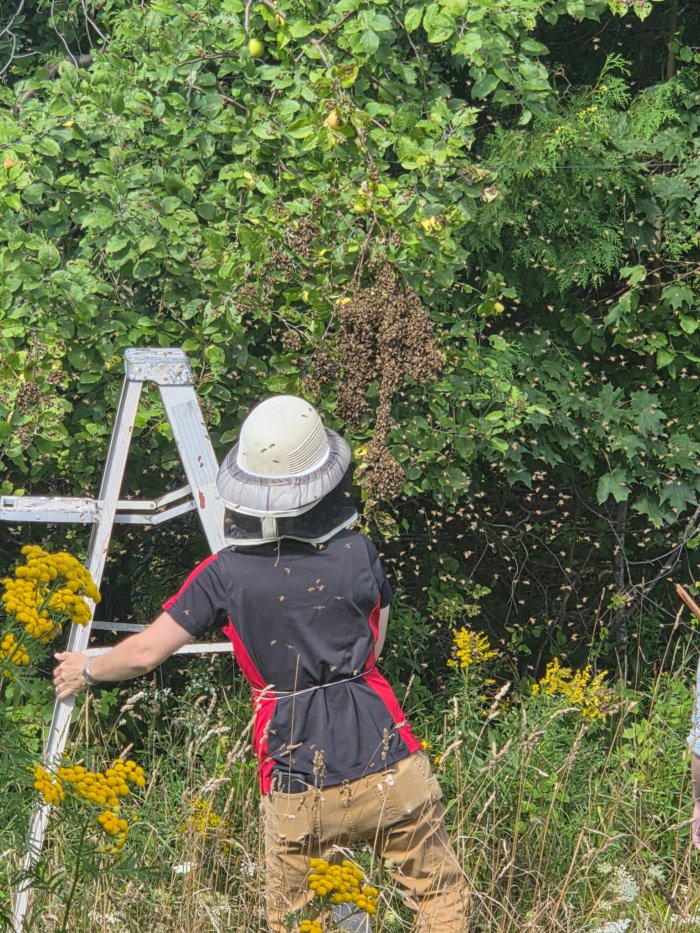
So, on Monday, August 25, 2025, Sandy noticed that one of our beehives had swarmed. She immediately called me to let me know what was up, but I wasn’t going to be able to get home for at least a couple of hours. So, she decided to go ahead and get the swarm into a beehive herself. This is actually a pretty straightforward task, and we had done it together a couple of times previously. All that is really necessary is to get a vacant hive box with some frames of comb in it, cut off the branches with bees swarming on them, and put them into the box.

As you can see from the fact that Sam is standing there holding the ladder without any protective gear, swarming honeybees are pretty mellow and very unlikely to sting. At this point, they don’t have a hive to defend as such, and as long as they are not personally being crushed or pinched they are just going to hang around.

This particular swarm was settled onto several branches, so as Sandy cut off branches and removed them she got pieces of the swarm. This particular branchful of bees probably was the one that had the queen in it, because as soon as she got it into the hive box everybody else started following it in.

And yes, all those little brown spots you see flying around in the air are in fact honeybees.
Once the bees were clearly heading for the box to be with their queen, Sandy put the inner cover on it and waited.

And all the bees that were flying around in the air shortly landed, and headed inside.

By the time I got home, they were all pretty much inside, and all I had to do was to add another box full of frames, and put the outer cover on it.
So anyway, swarming is the way that hives of bees naturally reproduce. The way it works is this:
- Once the hive has stored up a bunch of honey and has raised enough brood to be crowded, the worker bees will construct some queen cells. The eggs that the current queen lays in them are then fed heavily with “royal jelly” so that the larvae will mature into queens instead of workers.
- Once the queen cells are capped to pupate into mature queens, the old queen gets together with about half of the adult bees in the hive. They then fly out as a swarm like the one we see here, and settle on a convenient branch or structure to get themselves organized.
- The swarm will hang out on this first location for some indefinite period until the scout bees identify a good new colony site. This could be as short as a few minutes, or as long as a couple of days. This is the point where a beekeeper has the opportunity to offer the colony a new hive box as a home.
- In the event that the beekeeper doesn’t get there in time, the swarm will eventually take off again to a site that their scouts have identified, and start a new colony there. They will immediately start building honeycomb so that their queen can start laying eggs to raise up into new brood, and then start going out to bring in nectar and pollen to get the new hive started.
A beehive box is a pretty attractive site for a colony, particularly if it has some honeycomb already present in it so that they can start laying eggs, raising more brood, and storing honey right away. So, more often than not, if a beekeeper provides them one they will accept it and move in pretty briskly. Sometimes it isn’t even necessary to intervene. Earlier this summer, I had an empty hive out in the apiary that had comb in it so that I could add them to the other hives as needed in the season, and one fine day a swarm landed on it and moved right in.
The main issue is that this was a very late-season swarm. Our main honey flow was just ending at this point, so left to their own devices they weren’t going to be able to store enough honey to get through the winter. So, I immediately started feeding them sugar syrup as a supplement to the flower nectar. Before we were done, they had taken in almost 40 pounds of sugar (dissolved in water) to raise brood to overwinter, build new comb, and to store away as winter food.
So, with any luck they should overwinter OK, and should be going gangbusters come spring.
This took me down a bit of a rabbit hole of Googling, as I started wondering how many times a queen bee could break away and start a new hive. I would’ve thought that with months/years of just laying eggs and not much else, her flight skills/hardware would be too atrophied to fly her away from her hive. I couldn’t find any definitive answer on this though.