
Archaeological Interlude – Mystery Structure
This is a bit of a break from plants and animals. Instead, we will be looking at an odd, unidentified structure my family and I stumbled across while out for a walk on May 23, 2021. At the bottom of the hill we live on, there is a trail that was formerly a railroad, but the tracks have been taken up and it was converted to a snowmobile/ATV trail. At the point where the trail crosses our road, there are concrete pylons that used to hold up a railroad bridge that crossed the creek valley.
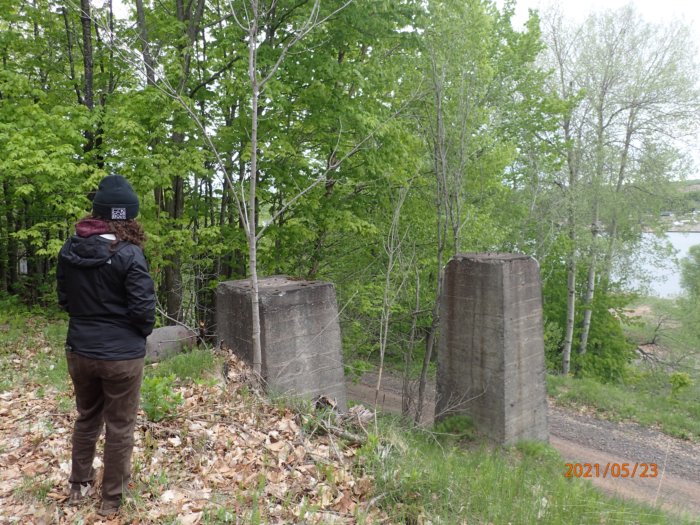
These aren’t the mystery. The mystery is this tunnel that was constructed into the hillside, right next to the concrete pylons. We have walked through here many times before and never noticed it, but it is possible that the entrance was covered over with soil and only recently eroded away enough to expose it.
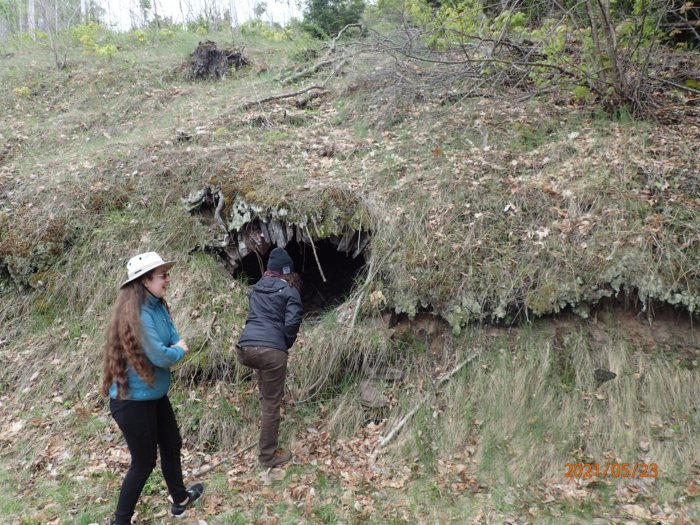
Someone put a lot of effort into building this tunnel, with flat rocks stacked to make a continuous arch.
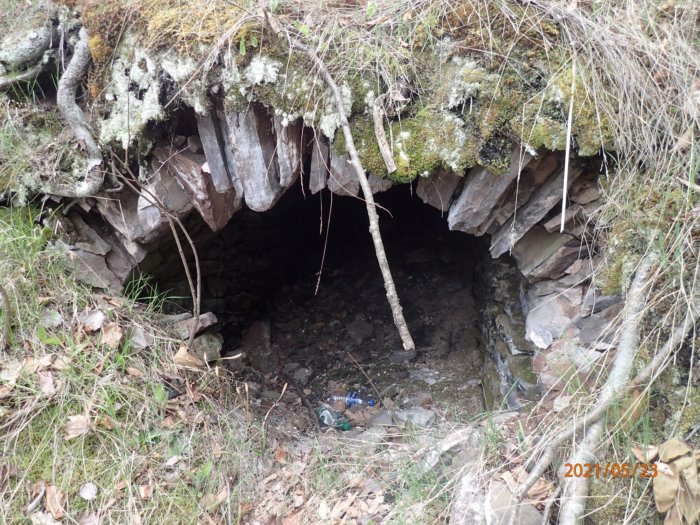
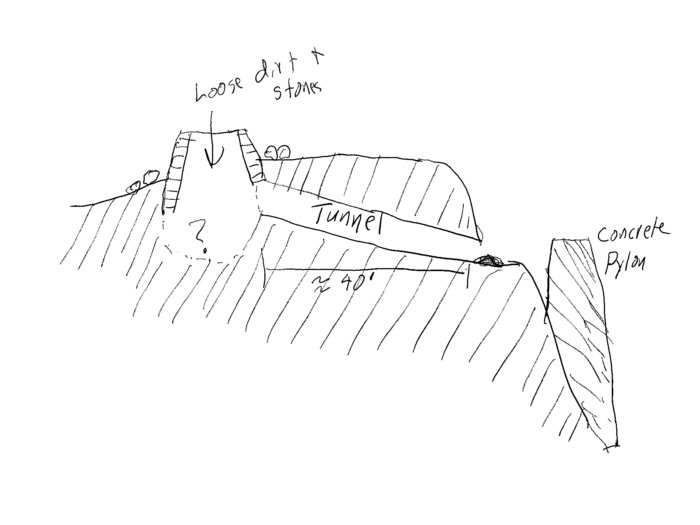
Inside, the tunnel is about 4-5 feet tall, and slopes generally upward into the hill. We didn’t go in, because it isn’t clear just how stable it is. The spot where a part of the roof has collapsed, and light is getting in, is somewhere around 40 feet down the tunnel.
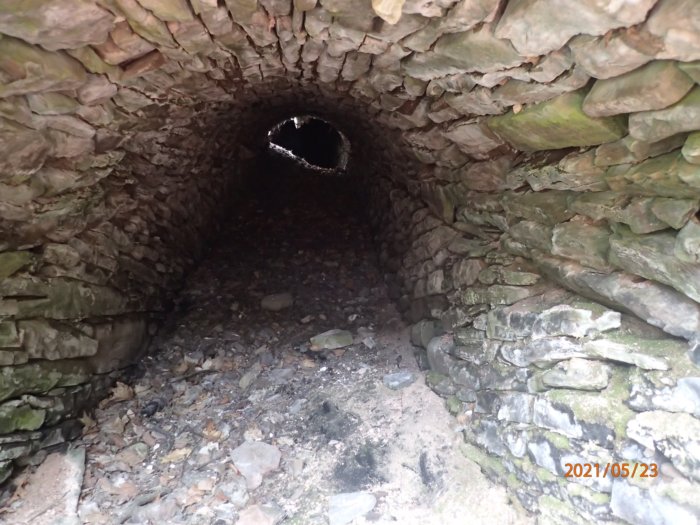
As far as where this tunnel goes, it appears to go to this cylindrical structure up on top of the hill:
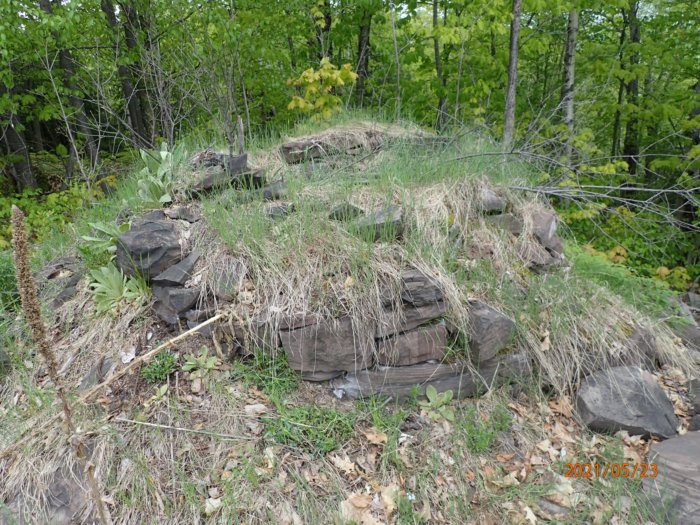
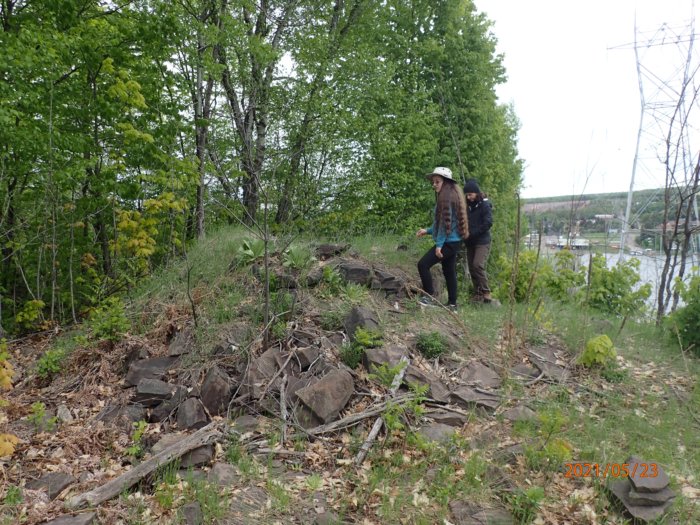
Here is a wider view of the surface structure. As you can see, it is pretty much on top of the hill.
Here is a sketch showing how I think the surface structure and the tunnel are related to each other:
As far as what this was actually for, I haven’t got any clue. Given the proximity of the concrete pylons for the railroad bridge, it may well have something to do with the railroad, but I don’t know what. There was also both active copper mining and lumbering activity at the time, and it could have had some connection to those. It runs very close to the current high-tension power lines that supply electricity to the whole Keweenaw Peninsula, but I expect it predates the power lines by quite a few decades.
Whatever it was for, someone thought it was important enough to put a considerable amount of effort into constructing it. The flat stones look like they came from a shale bed at the bottom of the hill, so the stones had to be broken loose and hauled up about a 40 foot hill to get here. The surface structure looks vaguely like a chimney or a shaft furnace, but we didn’t see any obvious evidence that there was ever a fire in it.
So, any ideas as to what this might have been for? It most likely would have been constructed sometime in the middle to late 1800s.
Added July 13, 2021:
So, it is looking more like this tunnel was related to some sort of combustion process. Our friend Phil collected some material from the tunnel floor that has the appearance and texture of soot when I looked at it under a microscope. There doesn’t look like there is much soot on the roof of the tunnel, but moisture condensing on the roof and dripping down all these years might very well have washed all the soot to the floor. I also ran an X-ray fluorescence analysis on it in the lab, and it appears to be mostly carbon, but with significant amounts of silicon, calcium and iron. This would be consistent with some sort of smelting operation, although I didn’t find any copper in it. The iron in the soot actually suggests that maybe they were working iron – possibly a forge?
On the hillside just to the west of the tunnel mouth, I poked around and found large numbers of coal lumps, mostly about the size of a golf ball. It looks like there was a pile of coal stacked on that hillside for some time.
So overall, I think this was a chimney arrangement for some kind of metalworking operation. The actual site of whatever type of furnace it was, would have been pushed aside and destroyed when the railroad was built through the site.
Added February 8, 2022:
Our friend John, a mining engineer and expert on the local mines, gave us this diagram of where the old Atlantic Mine Mill was located:

And the answer is, “Yes”. The hand-drawn arrow is pointing to exactly where we found this structure. Apparently the Old Atlantic Mill was the first attempt at building a smelter for the copper coming from the Atlantic Mine, and what we found was what was left of its chimney. The tunnel was leading from the actual furnace to the chimney base. I am told that this mill was not a success, and after a short period of operation it was replaced by the Michigan Smelter just down the road.
And this answers another question. Our road is named “Old Mill Hill Road”, but it was not clear what the “Old Mill” might have been. Evidently, it was the Old Atlantic Mill that the road is named after.
————————————
Honestly (but not seriously), what the surface structure looks the most like, is one of the vents leading down to the Morlock tunnels in the 1960 film version of The Time Machine

Comments are closed.
Hope you will let us know if you solve the mystery. Very curious.
The stones on the roof are the strange part to me. Why wouldn’t you use timbers?
It kind of depends on what it was for. A friend of ours was poking around in it, and found that the rocks seem to have been coated with soot at one point, and the floor appears to be covered with soot that flaked off of the roof rocks. I’m going to see if I can analyze this in the lab to confirm whether or not it is soot. I also found a lot of coal on the ground just west of the tunnel. This suggests that it might have been a chimney for some sort of furnace, in which case shoring it up with timbers would have been A Bad Idea.
We’re thinking now that it might have been a chimney for a small copper smelter that maybe didn’t work properly, and so was abandoned when they built a better smelter about a mile further down the canal. Unfortunately, they didn’t keep much in the way of records around here in the 1860s, which is looking like the right time period, and so it won’t be easy to check on this.
Anything to do with the underground railroad?
Sara: It is pretty unlikely that this had anything to do with human transportation of any kind. First, it is less than 100 feet long, and doesn’t actually go anywhere that people would want to go. It’s just a tunnel to the top of a not-particularly-hard-to-climb hill. Second, I doubt it relates to the Underground Railroad specifically, since Houghton is not really on the way from anywhere to anywhere else. Anyone fleeing from the south in the mid-1800s would have had to go through hundreds of miles of nearly impassible wilderness to get up to here. And once here, they would find themselves at a dead end, with Lake Superior blocking them from getting north into Canada.