
House Pseudoscorpion
What timing! I’d just gotten the camera mounted to take nice, high-magnification photos of tiny things, and then S. tells me there is a pseudoscorpion in the bathtub, just *begging* to be photographed. So, here it is:
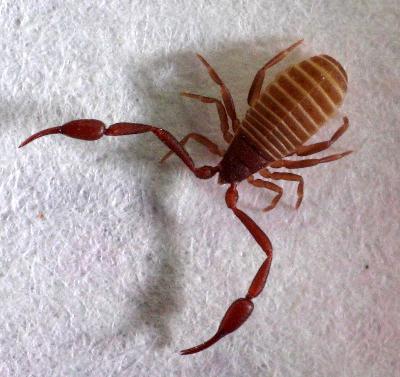
Then, we flipped it over to have a look at the underside:

And then, finally, zoomed in on one claw:

Considering that this little guy was only about 3 mm long, I think the photos came out pretty sharp. We figured that this should be good enough to get a full, positive ID, so I found an identification key to the pseudoscorpions of Michigan in the MTU library[1] . . . and had my illusions pretty much dashed. It turns out that you distinguish pseudoscorpion species from each other based on very fine details of the claws, and where exactly the sensory hairs (setae) are located. Unfortunately, even though the claw detail photo is pretty good, it isn’t good enough to count setae. According to the author of the ID key, even an expert might take as much as a week to prepare, dissect, and examine a pseudoscorpion to determine the species. There are supposed to be at least 29 species in Michigan, so the next ones we find might get taken in to the lab for a more thorough examination.
While a really positive ID isn’t practical from these photos, the fact that it was in the house (and, specifically, in the tub) means it was almost certainly Chelifer cancroides, also known as the “house pseudoscorpion” or “book scorpion”. This is a “cosmopolitan” species, meaning that we have carried it around the world and it pretty much lives everywhere that humans live. They are actually very common, but are rarely seen except when they, say, venture into the bathtub to get water. They spend the rest of their time eating other, even smaller arthropods (mites, clothes moth larvae, and the like), and generally get dismissed as being harmless and of no economic impact. They are reported to live for 2-3 years, which is pretty good for such tiny creatures.
Even though they look superficially like scorpions, they are in a separate order (Pseudoscorpiones), and are about as closely related to spiders as they are to scorpions. Instead of poisoned tails, they have venom glands in their claws that they use to kill prey. Of course, at less than about 3 mm long even for the largest species, they are completely incapable of breaking the skin of a human, so their venom is irrelevant to us. Pseudoscorpions frequently get around by hitching a ride on other insects, like the one in this rather startling picture.
[1] Sigurd Nelson Jr., (1975), “A Systematic Study of Michigan Pseudoscorpionida (Arachnida)”, The American Midland Naturalist, Vol. 93, No. 2, April 1975, pp. 257-301
Comments are closed.
Hi! I just discovered your website today, while searching for some good sources of pseudoscorpion photos and resources. I’ve written a children’s article on these “bugs,” and am looking for an expert to check it for accuracy. I’m wondering if you could share the name of the contact who tried to ID this critter for you? Also, I would love to mention your photo as a possible supplement to the article when I submit it to mags.
Thanks,
buglady
I never actually spoke to or corresponded with him, but most of my information about pseudoscorpions came from Sigurd Nelson, who wrote this page on the Michigan Entomological Society’s “Entomology Notes” site. He is the only actual pseudoscorpion expert that I am aware of. Unfortunately, his contact information on the Entomology Notes page is obsolete, he isn’t at SUNY-Oswego anymore (I expect he is retired, assuming he is still alive). Sorry I can’t be more help here. You could try contacting the Division of Insects at the University of Michigan Museum of Zoology, there is a good chance that they can recommend someone.
Please go ahead and mention my photo as a supplement in your article, that would be fine.
These are such great photos. Before today, I hadn’t known that there were such insects; I found one among my books this morning and was trying to figure out what it is. Having just moved to this state, I find this website very helpful and interesting to say the least. Thank you!
Howdy from Painesdale. I just found one of these in my bathroom and was trying to id it online…little did I know the answer would come from a local source!
I have the subject in a pill bottle if you want it, otherwise I’ll release him to eat more dust mites!
I’m glad to have been helpful, my original plan was to be useful specifically to people near me, so it’s good to hear of a case where it worked that way.
I understand that pseudoscorpions don’t do well in captivity, and I don’t save dead specimens (it’s a lot of work and takes a lot of space to make and maintain a proper insect collection), so go ahead and let it go. Amusing little fellows, though, aren’t they?
hey Tim!
I just found this website while looking for a moth and then I noticed on your header was what I have named “Bob” because I had no idea what they were. I have been saving them from drowning in my shower since I first saw them. I am so happy to finally be able to know what my Bobs are ^_^ thank you for all the help! keep up the good work! If you like I have a video. It’s not the greatest quality because it was taken with a webcam. Here is the link:
http://www.youtube.com/watch?v=HzO6pTuOYFg
Heh. I didn’t really think that anyone would be able to make an identification from the header images. Maybe we need more than just one spider and a pseudoscorpion up there!
id recognize bob anyday 😛 yeah maybe some more creepy crawlies up there
Hello from Washington! I’m wondering if you would be willing to give us your permission to use the pseudoscorpion picture you took in one of our environmental education videos that will be posted on YouTube and Vimeo. We would include a credit to this website as well.
Thanks!
you can use my youtube video if it is any help but it probably isn’t.
I just saw one of these the other day in amongst some papers & wondered what it was! And then I saw the one on the front page of your blog and lo & behold! I only recently found your blog & love it already. I love bugs, insects & spiders; my husband is kind enough to let me put the spiders outside when he finds them in the house. Except the Yellow Sac spiders. I don’t like those much! Keep up the good work. Very interesting stuff!
Okay, my son found one of these on our basement stairs. I see that many of the people posting here are intrigued and seem to love the little critters, but I want to know what to do to get rid of them. Sorry, but I’m not happy to share my home with them. Any thoughts?
Enis:
Pseudoscorpions aren’t aggressive home-invaders like, say, cockroaches or silverfish. Anything that clears out the normal insects that get into houses, would also eliminate the pseudoscorpions. And, since the pseudoscorpions are predators, they are not the primary small arthopods in your house, anyway – it’s the things that they are eating that are common.
In general, if you just try to eliminate moist spots (leaking sink drains, sweating pipes, basement condensation, boxes resting directly on cement floors, etc), then the sorts of things that pseudoscorpions eat will die off, and the pseudoscorpions themselves will move on as well.
Tim,
Thanks for that info. This is the first time we’ve seen one of these. Our basement sump pump recently stopped working and we had a bit of water seep in under a wall. Perhaps that’s what has attracted the yummies the pseudoscorpions are finding so delectable. I like the idea that drying out the basement should do the trick. I wasn’t crazy about using pesticides or other drastic means. Thanks again for the info.
thank you for the article…this morning I reached for a book to read, got as far as the third page and something that looks similar to your pic (little rounder rear, thinner ‘claws’) crawled out from the binding…ironic to me (who sadly, has a fear of spiders) that the book in question was a Stephen King…my little “guest” seemed to be younger than your subject, had that ‘amber’ look about him…cannot tell you how VERY happy it makes me to know that they are essentially harmless (to humans & pets anyways) THANK YOU
another question about the little guys, is there a safer way for them to get a drink? i hate seeing them in the tub, half dead because they are drowning themselves. 🙁
My sister found one in her bathroom, didn’t knowing what it was. Thanks for the info. !!
Craig: Glad to help!
Hello from Maine…found something that what I thought was a tick crawling on our wall so I grabbed it up with a piece of tape then noticed the long “claw” legs jutting out towards the front of it and was like this is not any tick I have seen. So I started doing research to find out what it might be. We have 3 kids and 3 animals in the house. I Googled crab like tick and one of the names came up pseudoscorpion so I clicked on “your link” and sure enough it looks just like your pictures (magnified of course). Thank you for your information.
Nice! I have been searching for pseudoscorpions in leaf litter near my house. No success so far…
Ernie:
Have you considered trying a variation of the Tullgren Funnel on the leaf litter? This is supposed to be a good way of getting all of the small arthropods in the litter to move into a collection jar. They normally use some sort of preserving fluid in the bottom, but I don’t see any reason why it couldn’t just be an empty jar if one wanted to collect the specimens alive for photography.
Thanks…yes I might resort to using a Tullgren funnel if I have to. I have been sorting leaf litter on a white drop sheet. Of course I just might not be seeing them! ha!
Nice site ou have!
macrocritters.wordpress.com/
Hi! Sometime ago I found one pseudoscorpion crawling on the stairs inside my house.
I haven’t seen it anymore after that even I’ve tried to watch carefully.
Is there a way to lure them in a trap so I could take photos of it? Tullgren funnel is one option but it needs soil from outside and I’m not sure if there’s any of those outside of my house… maybe it just likes the to live in basement.
Mikko: I’ve never caught a pseudoscorpion on purpose, they just turn up in the sink or bathtub from time to time. They might be attracted to moisture, you might turn up some by looking under things stored in the more humid parts of your basement.
Ok, thanks. I’ll try to check from the basement.
I was fortunate(?) to find one of these on the edge of my bathtub last week and was sort of freaked out by it. Sent it to school w/ my son and had his biology teacher identify it for me. Having recently returned from a trip to New Orleans, I thought for SURE we had taken it home in our suitcase, but it sounds like it just might have come from the woods out in my backyard, having recently taken in some dead twigs for a fall display. At any rate, I was thankful to learn they are quite harmless and when/if I ever see another (highly unlikely, I’m thinking!), I’ll probably leave it be, although I still have issues sharing my living space with other “creatures”, no matter how harmless they are!
We had an infestation of wandering red dots in our paperbacks…. these things were smaller than the periods. As in slightly more real than “eye floaties” perceptible.
“Book scorpions” seems to be the common name of something that is larger than the things we had.
I think I found one in my bathtub. I’m in Michigan and it’s like 0 degrees outside. Found it floating in my bathwater. Scared me to death. Ugly little critter.
I just discovered these little guys tonight but it was in my room by my window. Curious to why I found him there rather than in the bathroom like the rest of your readers.
Tessa:
While we most often see them in the bathroom, they can turn up most anywhere. They like a little water from time to time, but they don’t really mind dry environments, especially in the summer when it is a bit humid.
I kind of suspect that it doesn’t much matter where you look, if you examine any part of your house closely you are likely to see them from time to time. They are just more obvious in, say, a white sink or bathtub than they are in the dust under the bed.
Tessa I discovered my first on my sons SHEET. NOT impressed! I’m just praying we don’t have any rodent nests close by:( as I read they can coexist with them..yikes!
Dear Mr Tim Eisele,
the Natural History Museum of the University of Tartu (in Estonia; virtually also at http://natmuseum.ut.ee) wishes to use your photograph of house pseudoscorpion Chelifer cancroides (http://somethingscrawlinginmyhair.com/wp-content/uploads/2007/09/pseudoscorpion_sharpfocus588k.jpg) in composing our new permanent exhibition.
We would be very grateful if you would contact us, writing to me, so we could discuss it further.
I just found one of these babies on our shower wall! There has been an onslaught of tick sightings in our area and I was afraid we were the latest hosts. Luckily, I came across your picture and was able to identify our guest as a pseudoscorpion.. What a relief! We are located in Eastern Passage, Nova Scotia, and had never heard of these wee critters until today. Thank you for the helpful info!