
Local Field Guides
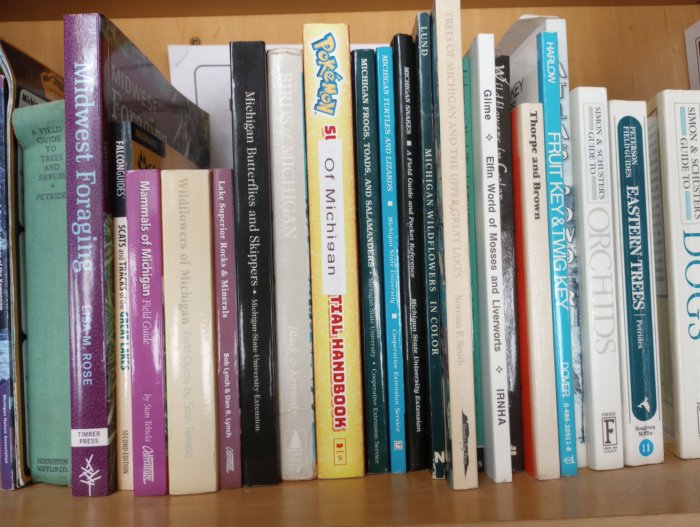
The snow just melted off over the past week, and we don’t really have much in the way of new bugs or plants to photograph yet, so I wanted to take a moment to talk about field guides. The picture above is only part of our field guide shelf, but it is the one that we use the most. If you look at the titles, you will see that a lot of them have the words “Of Michigan” or “Of the Great Lakes” in them. I love these, because this is where we are. When I want to identify something that we are actually seeing outdoors, it is way easier to find them in the book if it isn’t diluted by all the things that would never be found within a thousand miles of here. For example, if we find a turtle out basking in the sun, it is way faster to find them in the book if there are only about a dozen candidates, as opposed to the hundreds that are found all across North America. And if we find a lizard, we know that it is almost certainly the single species of lizard that is definitely native to the Great Lakes region, and not one of the numerous types that live in the desert, or in Florida, or what have you. Florida in particular makes general-purpose field guides unwieldy, if you look at a North American Birds guidebook, it seems like almost half of them are only in there because they are tropical species that range up into Florida.
I will grant that not everyplace has really specific guidebooks like this, but in general one can at least get ones that are narrowed down into one quadrant of the country – if I can’t get something specific to Michigan, I can usually at least find something for, say, Northeastern North America.
A good place to find these is actually in tourist gift-shops[1]. I realize that most people don’t generally go into the tourist traps in their own hometown, but they often do have quite a bit of locally-relevant reference materials.
Historically, my favorite source for these sorts of things was the Michigan State University Cooperative Extension Service. They published five of the guides in the picture above, and they are good, comprehensive information. The only problem is that I have just been hunting around on the MSU Extension Website, and there doesn’t seem to be a direct link anymore to their field-guide-type publications. There is a tab for “publications” at the bottom, but that brings up everything.
I am actually afraid that the availability of good-quality image searching online might be bringing about the demise of the pocket field guide, and MSU Extension may be getting out of the business – I did manage to find a few specific ones using the search function, and they look like most of them haven’t been updated in over a decade. Oh well, I will keep using the ones I have, at least. It’s somehow more satisfying to actually find it in the book myself, than to just hand over a picture to Google Image Search and accept its judgement.
[1] We have quite a number of these locally, probably more than is typical. We were visiting Bar Harbor in Maine some years ago, and as Sam was noting that there were certain points of similarity between Bar Harbor and Houghton, she suddenly had a look of having had an epiphany, and announced, “Hey, WE live in a tourist trap!”