On December 5, we got a Christmas tree. Sam picked out a Balsam Fir, which we brought home and set up, with no particular problems[1]. But then, on December 22, S_ found a few dozen of these little guys suddenly appearing in the house. Coincidence? I think not.

Michelle[1] sent me this set of pictures of a spider on the cut end of a log some time ago, but I have just now settled down to try and figure out what kind of spider it actually is.

While we did find this one inside the house, it was our own fault: he was carried in on some lettuce that we harvested from the garden in August.

For scale, that’s my knuckle he was crawling on, so he was not very big – about 6 or 7 mm long, and pretty skinny.
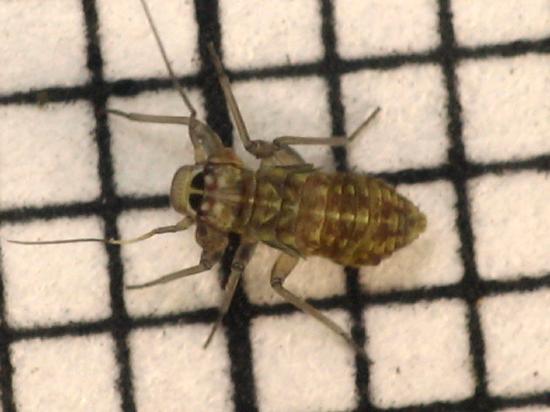
So, this past summer while we were at a friend’s Canada Day[1] party, Sam and I spotted a number of these little guys crawling around on the wooden frame of their swingset. Since the graph paper squares are only 1 mm, that makes this particular one only about 2 mm long.
And here we have yet another huge sphinx moth that was drawn to our porch light on June 22.

This is most likely a Waved Sphinx, Ceratomia undulosa, so named because of the wavy pattern across the back of the wings. This particular one also has a mark on its shoulders that I think looks quite a lot like a face [1].
Here’s another sphinx moth for you. S_ caught this one in the end of June, about a week after last week’s Modest Sphinx. It was also found hanging out near a porch light. It’s not quite as big as the Modest Sphinx, but it’s still quite a bruiser with a body considerably longer than the width of my finger.

On June 22, we turned on the porch light and waited for sundown to see what would be drawn to the light. We didn’t get anything until about 11:00[1], but then I heard something going “Whump! Whump! Whump!” on the window. I thought it was something like a crazed bat at first, it was pretty big. But then, once I netted it, this is what we found:

There are several different kinds of small orange-and-black butterflies around here in the summer. They mostly look about the same from a distance, and telling them apart requires actually catching them for a close look. A lot of them hang around on lawns, so they are easy enough to catch with a standard butterfly net. Here is one of them that Sam caught back in the middle of June:

This beetle was photographed back in August. I’m not sure whether to classify this as a “found in house” or “found in yard”, because this particular one was hanging out on the doorjam and was most likely trying to get in when it died there. Most summers, we get significant eruptions of them, although this year they were not as common as they have been in the past.

Aside from the color, they are generally similar to the Clover weevils that are also pretty common around here, with the blunt, short snouts and the armored wing covers that wrap quite a way around the abdomen.
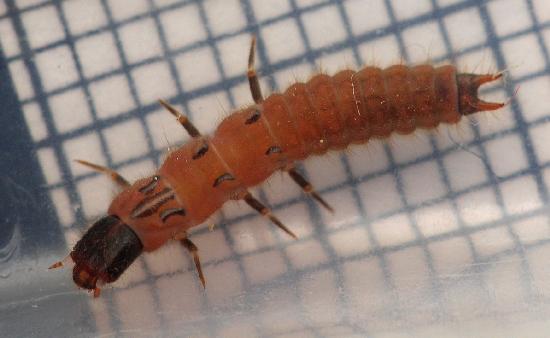
Last Sunday, we found this larva in a corner of Sam’s dresser drawer. It was pretty hard to catch, it could run quite fast and could easily squeeze down into small crevices in the wood, but eventually I got it into a small plastic container and got it up to the camera.