
We had quite a plague of these European Earwigs (Forficula auricularia)[1] back in July, when there was still some moisture about. Now that it has been very dry for a few months their numbers have plummeted, but for a while there we were literally finding heaps of them every time we turned over a rock or picked up a board.

These are actually two different harvestmen[1]. The first one was photographed without the macro lens on a wall last year, and while it shows the spread of the legs nicely, there isn’t much detail on the body.

We’d all just come into the house after going for a walk, and I heard Sam shouting from the kitchen “Mom, Mom, a beetle! A beetle!”, and then I heard S_ reply, “A beetle? Where is . . . Holy Cow!” So I come over to look, and they’ve got this huge scarab beetle, just about two inches long[1].

Last year I had a picture of an adult Ctenucha virginica, a striking black-and-orange tiger moth with an unpronounceable name. Well, this spring (on May 10), I found the caterpillar of the same species, climbing up a grass stem.
 .
.
I put out what was supposed to be a cricket trap[1] a few days ago, but didn’t catch any crickets. What I did catch were some woodlice, something that looks like a carrion beetle larva, but I keep finding them scampering around where there is no evidence of any carrion, a stone centipede, and a few tiny things that included this little orange mite:

This one landed on me while I was out pushing Sam on her swing. At first, I thought it was a wasp, because that’s what it looked and acted like while it was flying, but as soon as it landed and closed its wings, it was clearly a rather attractive beetle.

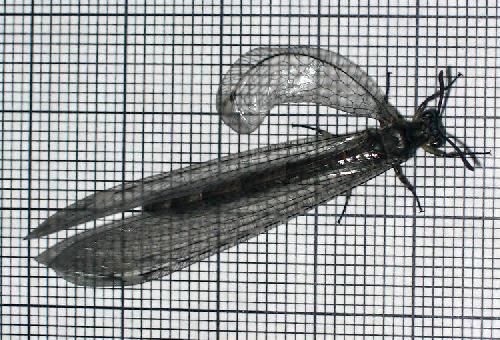
Last year, I had an entry about ant lions, with pictures of the larval form (which digs pits in sandy soil and grabs unwary insects that stumble ino them). Well, here is the adult form, that S_ just caught for me out on the front porch:
Back on May 10, this is one of the things that Sam and I found under a rock. We didn’t spot it at first, because it looked a great deal like a small plant root – at least until it moved. It’s almost two centimeters long, but less than a millimeter wide.

Here’s one that probably everybody in North America has at least heard, if not seen: field crickets. I recorded this sound clip on June 17, which was when the spring field crickets (Gryllus veletis) started singing[1].
Sam found this one under her crib on May 27. It’s a rather striking gold-colored beetle with intricate tracery on the wing covers.

This is certainly one of the Calligrapha leaf beetles[1]. Based on the dark green pronotum (the plate between the head and the wing covers), it looks like it is related to Calligrapha alni, the Russet Alder Leaf Beetle. I’m not so sure it is that exact species, though. While the pattern on the wing covers is very close, the examples in Bug Guide show more of a rusty coloration, and a bit less gold.