
What timing! I’d just gotten the camera mounted to take nice, high-magnification photos of tiny things, and then S. tells me there is a pseudoscorpion in the bathtub, just *begging* to be photographed. So, here it is:
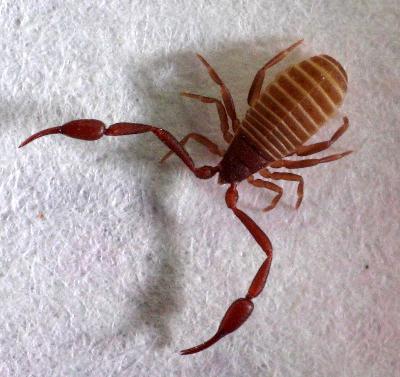
Then, we flipped it over to have a look at the underside:

And then, finally, zoomed in on one claw:

Considering that this little guy was only about 3 mm long, I think the photos came out pretty sharp. We figured that this should be good enough to get a full, positive ID, so I found an identification key to the pseudoscorpions of Michigan in the MTU library[1] . . . and had my illusions pretty much dashed. It turns out that you distinguish pseudoscorpion species from each other based on very fine details of the claws, and where exactly the sensory hairs (setae) are located. Unfortunately, even though the claw detail photo is pretty good, it isn’t good enough to count setae. According to the author of the ID key, even an expert might take as much as a week to prepare, dissect, and examine a pseudoscorpion to determine the species. There are supposed to be at least 29 species in Michigan, so the next ones we find might get taken in to the lab for a more thorough examination.
While a really positive ID isn’t practical from these photos, the fact that it was in the house (and, specifically, in the tub) means it was almost certainly Chelifer cancroides, also known as the “house pseudoscorpion” or “book scorpion”. This is a “cosmopolitan” species, meaning that we have carried it around the world and it pretty much lives everywhere that humans live. They are actually very common, but are rarely seen except when they, say, venture into the bathtub to get water. They spend the rest of their time eating other, even smaller arthropods (mites, clothes moth larvae, and the like), and generally get dismissed as being harmless and of no economic impact. They are reported to live for 2-3 years, which is pretty good for such tiny creatures.
The spider below had made a minimalist mesh-style web on the frame of our back door, so I took a bunch of pictures in-place with the improvised macro lens. By bracing against the surface of the door and taking lots of pictures, I managed to get a few that showed decent detail, but it was a lot of effort. Keep in mind that this is a little guy, only about 5 millimeters long. If there had not been a surface to brace against, there is no way I could have held the camera still enough to get an unblurred photograph.

But, not to worry! We have so much forgotten junk in the lab, there must be something that can be used to hold a camera steady, right?
Right! I would like you to meet “The Beast”, about 10 pounds of the finest brass machining the 19th century had to offer![1]

I found this old microscope frame stuck away in the back of a cabinet, along with a bunch of other microscope parts that were probably scrapped out sometime before I was born. This one was obviously the stage and mount for a dissecting scope, the mount is a nice 3-dimension positioner, moving up/down/forward/back/left/right with several inches of travel in each direction. With a bit of adaptation (mainly just getting a 1/4-20 capscrew to mount the camera, and drilling one hole so that the screw would fit), the camera and macro lens mounted up just fine.
This week, we have another one that can be positively identified down to the species. It is an Indian Meal Moth, Plodia interpunctella. These are commonly referred to as a “pantry pest”, and we found this one (surprise, surprise!) in the pantry. They came in to the house originally in some infested birdseed from WalMart, and they’ve been around at a low level ever since. They feed on dry grains, flour, and similar materials.
There are two photos here, because of focusing issues with my setup for small items. The first one has the head in focus, while the second is focused on the trailing edge of the wings.
Ah, the simplifications of death . . .
On the photography front, it turns out that death greatly simplifies things. I found the green lacewing (family Chrysopidae) below as a tiny, pathetic corpse hanging in a corner near our front door, where it had been caught in a spiderweb sometime last year. All things considered, it was pretty well preserved, and it certainly wasn’t going anywhere, so I could photograph it to my heart’s content. The only downside was that, since it is (a) dried out, and (b) a bit encumbered with spider silk, it isn’t really identifiable down to the genus or species level. Lacewings are very 3-dimensional because of the way they hold their wings. Since close-up photography has a rather limited depth-of-field, it was hard to both see the wing detail, and the body. So, there are two pictures, the first concentrating on the wings and the second on the body. Hopefully, I’ll be able to find a lacewing larva sometime this summer, they are interestingly evil-looking critters.

It’s spring! I no longer have to find arthropods under junk in the basement! Now the biggest issue in photographing them is speed – most insects, spiders, and centipedes move so quick that it’s hard to get a picture. I tried to get pictures of a ground beetle, a centipede, any of the thousands of flies that were popping out of hibernation, and a moth, and ended up with a lot of pictures either of fast-moving blurs, or of vacant spots where my subjects had been up until just a second ago.
Except for this one. This is a millipede, and based on the image at BugGuide [1], it is a member of the family Parajulidae. It was moving nice and slow, and allowed me to move it somewhere that there was good contrast, decent lighting [2], and nothing to hide behind.

This week’s arthropod is probably Porcellio scaber, the common rough woodlouse. I found these under a toolbox in the basement. We don’t have many of them at the moment, because the basement is currently quite dry. Since they are crustaceans and actually breathe through gills, woodlice can’t tolerate dry conditions because their gills dry out. In the summer, when condensation makes the basement kind of damp, they become much more plentiful. They seem to be eating mildew and similar organic debris.
This week’s arthropod is a lady beetle, most likely a Multicolored Asian Lady Beetle, Harmonia axyridis. When these first started getting into the house, we thought that we were being invaded by a dozen different species, because they vary in their shade of orange and in the number of spots. It turns out it is just an extremely variable species, though.
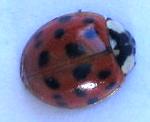

So, what is this all about anyway? Here’s the deal: We own 9 acres of property, and I’m going to try to document every macroscopic arthropod I can find on it. This includes insects, spiders, other arachnids, crustaceans, and pretty much anything I find that has an exoskeleton. The plan is to post at least one species every week, with photographs and a description both of how I found it and what I think it is. I expect this project to take some years, especially if I can manage to photograph all the eensy little guys that live in the leaf litter. So, in the spirit of having to start somewhere, let’s begin with this one:
This blog originally started on Livejournal, but what with one thing or another (in particular, the awkward way that livejournal manages photographs), I though it would be better to take my friend’s suggestion and migrate the “arthropod project” over to this site, where things can be set up to suit what I am trying to do here. So, even though the first slug of postings are all appearing in September, they actually had been written over a period starting in February 2007.
Update: I just realized a couple of days ago that there is an option to edit the timestamp on postings, so I’ve gone through and edited the early postings so that they now correspond to when they originally appeared on the old blog. So, now those first 30 or so postings are spread out in the archives from February to September instead of all clumped together on September 22. I could go on about how this makes it easier to access them through the monthly archives on the sidebar. But, really it was just bothering me that I’d made some references to the time of year that didn’t make sense if they were all posted in September.