The pine plantation west of our house was thinned back in 2014, and the stumps left behind from the cut trees have gotten pretty rotten and punky. And, on September 19 of 2020, we found these little pink fungusy things popping up between the growth rings.
read more…Red and Yellow Mushrooms from Maasto Hiihto
The Maasto Hiihto trails up north of Hancock are primarily cross-country skiing trails[1], but they are also open for general hiking when there is no snow on the ground. When we went up there on August 2, 2020, it had been raining for a while, and the mushrooms were popping up in some numbers. There were quite a number of these mostly-red ones, which were about the size of the palm of my hand.
read more…We found these bug nymphs on a piece of landscaping timber on September 15, 2019. Given the time of year, I think this is a hibernation aggregation. They were looking for a protected spot to overwinter.
read more…When one looks at the ecosystem of northern Michigan (along with the northern tier of US states and most of Canada), there is an unusual feature – on top of there being relatively few species compared to further south, there is a distinct lack of endemic species (species that live here and nowhere else). Practically everything that lives in this region belongs to widespread species with ranges that extend considerably south of here. This is in contrast to places like Florida, which has tens of thousands of species of invertebrates, and at least 1500 of them are considered endemic to Florida.
So why is that? Well, we can sum it up in one word: Glaciers.
As I mentioned earlier, Sandy and the girls took a trip to the South Dakota Badlands in June 2021.

On the evening of December 9, 2021, Sam and I were sitting in the living room reading our books, when I heard a noise from outside. “What’s that?” I said. “Is it the neighbor’s kids?” Sam listened a bit, and said “No, I think it’s a cat!” So we both immediately looked for our cat, and there she was, coming across the room looking intently at the back door with her tail like a bottle-brush. And then we heard the cat crying again, and it wasn’t her! So Sam went to the back door, opened it, and saw a startled cat suddenly dash off into the black locust stand beside the house. Now, by this point, it was dark and we already had close to a foot of snow on the ground, so it wasn’t really practical to pursue the cat into the brush. So we put out a bowl of food for it so it would hang around until we could come up with a plan.
read more…Sandy and the girls took a trip to The Badlands in South Dakota back in June 2021. I didn’t go with them (I had some work I wanted to get done, and somebody had to look after the dog, cat, and chickens), but they took some pictured for me. Like these pictures of cactus blossoms that they took on June 18, 2021.
read more…Now, I am not 100% certain that these are all the same species, since I didn’t actually keep the littlest one and raise it to adulthood. But, I think that it is pretty likely that they are. So, this first little feller was in our house on August 15, 2020:

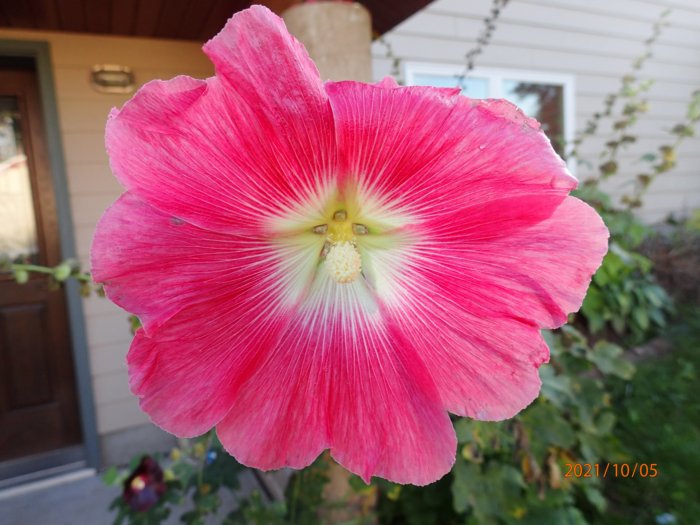
I have it on good authority that “Hollyhocks are the single prettiest flower grown on Earth.”[1] And we have some growing right next to our front door. They certainly have a long blooming season, they started flowering sometime in mid-summer, and the last few blossoms were still there on October 5, 2021.