
On June 8, 2015, Sam and I were walking out back and found that the dogwood blossoms were covered with numerous beetles. Including these attractive gold-and-dark-green beetles with script-like markings on their wing covers.

The girls found me this beetle on the window on June 7, 2015. I recognized it immediately.

It’s a Scarlet Malachite Beetle, Malachius aeneus. While I first found one of these in 2008, and then found a larva that we raised to an adult in 2010, I never really got a fully satisfactory set of pictures of the adults. So, let’s try again. This next picture is an exceptional pose that I rarely get – a beetle with wings fully extended:
As we were beach-hopping down the east coast of the Keeweenaw Peninsula on July 12, 2015, we found these two specimens. The first is similar to one that we’ve seen before – the enormous Elm Sawfly.

Woodland Ground Beetles From Bete Gris
Another thing we saw on our trip to Bete Gris on July 12, 2015, was a number of these beetles rummaging around the sand on the beach, right near the water line. They were jet-black, and actually looked like they were having a hard go of it due to the sand rolling around underfoot, and occasionally being hit by waves. Here’s one in my hand, so you can see that they are only medium-sized beetles.

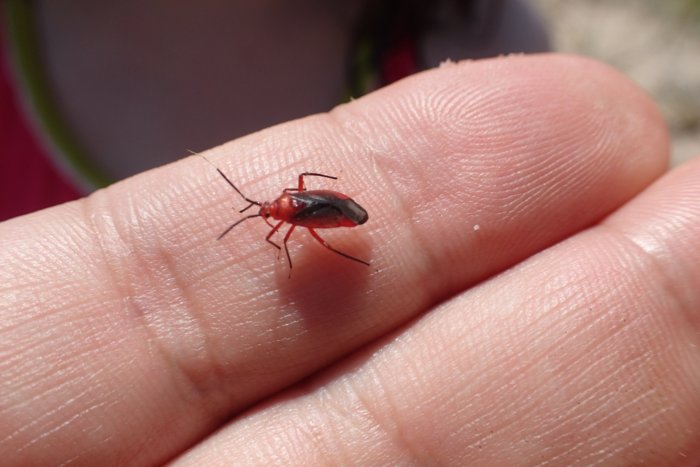
On July 12, 2015, we went up to Bete Gris Beach, on the east side of the Keeweenaw Peninsula. It was a nice day, and this is one of the few proper sandy beaches in the area[1]. Anyway, we spotted this bright-red bug that was willing to stand still enough on my hand and arm for pictures.
White Admiral, and a beat-up Crocus Geometer
The only really connection between these two insects is that Sam caught both of them on the same day, on June 29, 2015[1]. The first one is a White Admiral, Limentis arthemis. It is in somewhat better shape than the rather beat-up ones I posted earlier. Unfortunately, it was back-lit too much and it is hard to see the coloration on the upper surface of the wings, although the white stripe is clearly visible.

Insects Found While Crossing Lake Michigan
Earlier this year (2015), Sam had said that she wanted to see what it was like to travel on a “real ship”. So when we took a trip downstate on July 23, we went down to Manitowoc, Wisconsin so that we could cross Lake Michigan[1] on the SS Badger[2], the last remaining coal-powered passenger ship operating on the Great Lakes.

These pictures were taken almost exactly a year ago, on August 31, 2014, while I was out playing with my then-new Olympus TG-3 camera. The bee is on a goldenrod flower head.

Ah, but what kind of bee is it? There’s the question.
Black Fly Larvae and Water Striders
We were all up at a small stream near Eagle Harbor on July 19, 2015, where Sam and Rosie were busily rummaging around to see what they could catch in their nets. And we noticed a particular spot in the fairly rapidly-flowing stream where objects on the bottom were coated with these little black insect larvae. They were each only about 3 to 4 mm long.

Sam spotted this little black fellow on my shirt collar on May 27, 2015.

I say “fellow” because, well, just look at those huge pedipalps.