
Sandy has been planting milkweed near the house for the Monarch butterflies for some years now. On August 10, 2014, she noticed that some of the plants had an aphid infestation.

This was a bit unusual, as the species of aphid that is most commonly found on milkweed is bright yellow-orange, while these are dark colored to the point where they are nearly black (but with white legs). The things that look like lighter-colored, more spindly insects around them are shed aphid skins.
White Plume Moth with Hooked Wingtips
This pure-white plume moth from near the porch light on August 10, 2014 has a wingspan of 14 mm (a bit over half an inch), and has a fairly distinct hook at the tip of each wing.

Plume moths are notorious for being hard to identify, since a lot of them are brown shading to white (and evidently a lot of them vary from brown to white even within a single species)> But, from the body and wing shape, this one looks like it is at least related to the Morning Glory Plume Moth, Emmelina monodactyla
This long, slim moth from the August 10, 2014 porch-lighting had a body just 8 mm long. but the antennae stretch out long enough to just about double its body length.

While it looks pretty nondescript, the resting pose turns out to be a good ID feature, as very few micromoths perch with their antennae full forward like that (the “grass veneer” moths, which otherwise are the same size and shape, almost always drape their antennae over their backs instead). The pose is identical to what is seen in a lot of Casebearer Moths, like the Pistol Casebearers, in the genus Coleophora.
This moth from August 10, 2014 was only about 5 mm long (under a quarter of an inch), and was so tiny it could be mistaken for a bit of chaff. It looks like it has an eyespot at the tip of the wings, making it hard for a casual observer to tell which way it was facing. I’m not sure that this would make a lot of difference to a big predator, but maybe jumping spiders would be fooled?

There were a lot of little moths at the porch light on August 10, 2014. This sooty-gray one was something under a centimeter long (but was still bigger than some of the others).


Sandy found this caterpillar on August 12, 2014. It was crawling on the raised-bed garden frame that she’d just built in front of the house.
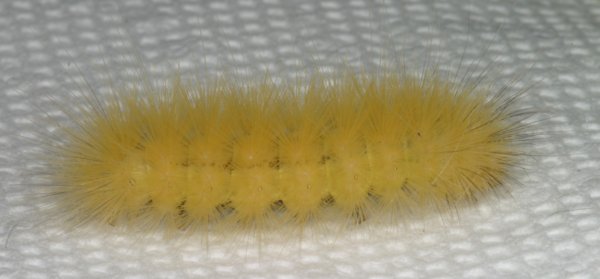
It looks to be fairly typical of the woolly caterpillars of the various tiger moths (Arctiini) aside from the color – most of them are dark, not golden yellow like this one.
Another moth from around the porch light on August 10, 2014. This one was reddish-brown, with a prominent tuft behind the head and two distinct white spots on the wings.

After rummaging through the Peterson Field Guide to Moths of Northeastern North America, I believe that this moth is Putnam’s Looper, Plusia putnami.
Back to the porch light on August 10, 2014, we drew in this white moth overnight. Looking at it, my first thought was, “Oh no, not another one of these plain white ones. I’ll never ID this!”

But then, I used Google to do a site: search of Bugguide.net for “white moth michigan”, and . . . there it was, fourth image. Exact match, right down to the wing vein pattern and the way it drapes its antennae down its back. It’s a Carrot-Seed Moth, Sitochroa palealis
Sam found this click beetle crawling on the sidewalk in front of the house on August 7, 2014. It was about half an inch long, fairly typical for a click beetle.

There are a number of red and black click beetles similar to this one in the genus Ampedus, and Ampedus apicatus in particular looks like a really good match, right down to the vaguely heart-shaped dark patch at the tips of the wing covers.
Sandy spotted this crawling on the house siding around our front door on August 3, 2014. While this specimen looks like an ant, she isn’t. She is a species of “Velvet Ant”, which are actually wingless, solitary wasps.
