
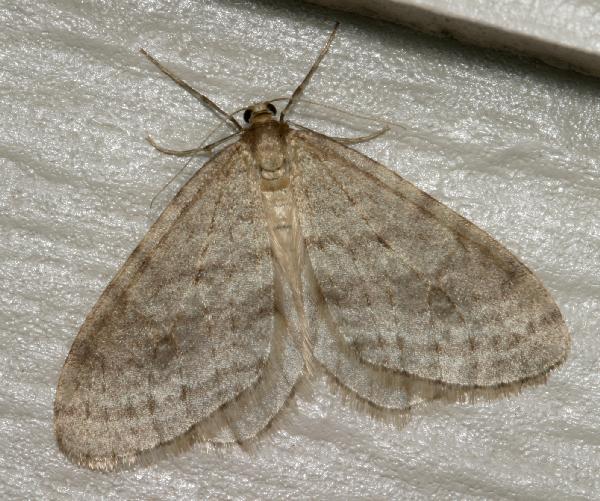
On November 4, 2012, I decided that since it wasn’t quite freezing out (it was 34 degrees F, or about 1 degree C), it was worthwhile to leave the porch light on overnight to see what we got. The biggest things were these two moths, one with slightly blurred markings:
Rosie likes to collect acorns, and had brought a bucket of them in the house on October 7, 2012. And while Sam was looking them over, she somehow broke one of them (I think she dropped it on the floor). And inside, there were several of these fat little white grubs.

Sandy found this insect on the inside of our kitchen window on October 5, 2012. It was about 3/4 inch long, and fast. I had to put it in one of our small, smooth, white ceramic bowls (which have walls too smooth for most insects to climb) so that I could get pictures without it running away.

This is a rather sad posting. On October 5, 2012, one of Sandy’s oldest tarantulas[1], a Costa Rican Zebra Tarantula, had a bad molt, and died. It was able to get its legs out OK, but the old skin around its abdomen didn’t split like it was supposed to, and it evidently couldn’t breathe.

Sam and Rosie found this nearly 2-inch caterpillar crawling across the road at Rosie’s preschool on September 22, 2012, so they brought it home for me.

While it is mostly uniform green, the white stripes running down the sides from the head all the way down the body, with an added brown streak on the head, looks a lot like the characteristic markings of an Angulose Prominent, Peridea angulosa.
On the morning of September 21, 2012, we found this pile of beetle parts about 20 feet from our front door. It was about the size of a tennis ball.

As it happens, Sandy had seen a skunk sniffing around the yard the previous evening, so we had a pretty good idea of who had left this little gift for us. Skunks are omnivorous, and the nature of their droppings depends a lot on what they had been eating. And this one had evidently found a nice cache of beetles.
On September 17, 2012, I spotted a couple of flies that had died horribly on our windows. They had been infected by a fungus that had bloated their abdomens, and then when they died the fungus sprayed spores in all directions (you can see the spores where they hit the window glass and stuck).

We were sitting at our picnic table in the yard on September 3, 2012 when this little yellow aphid landed on Sandy. Its body was about the length of this underscore ( _ ) if you are reading this in standard 12-point type [1].

Our last specimen from the August 23, 2012 orgy of sweep-netting is this slender brown bug (photographed while it was standing on my knuckle).

It’s a dead ringer for Protenor belfragei, a very common brown bug that doesn’t seem to have drawn enough attention from the general population to get called by a common name.
Little Brown Inchworm with Black Splotches
This little inchworm was caught by sweep-netting in the tall grass on August 23, 2012. It was busy trying to avoid notice by pretending to be a stick.

Sometimes, for variety, it would pretend to be a crooked stick. In this next picture, you can also see a small red mite near the bottom. The mite was barely visible to the naked eye, at about a millimeter.