
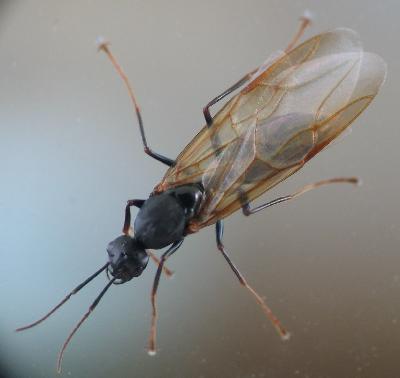
Powered flight using wings has evolved independently on Earth at least four times[1]. But as far as we can tell, insects did it first, and have exploited their innovation like crazy. To the point where they are the most plentiful flying organisms on earth by a massive margin. And the wings are used for everything from a kind of floating aimless flight, to fast-moving and highly-controlled maneuver.



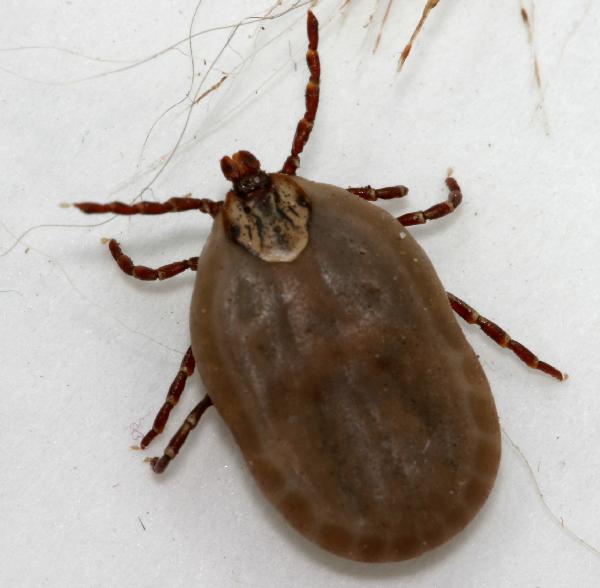
A while back, we acquired some guinea fowl, which we let run around the yard to eat ticks[1]. It actually seems to be working, the tick levels in our yard are way down. But not zero, as can be seen from these Wood Ticks, Dermacentor variabilis (also known as American Dog Ticks) that Sandy picked off of our poor old dog on June 3, 2012
Sandy found this caterpillar on one of our apple trees on June 1, 2012. It was fairly good sized (over an inch long).

We tried rearing it, but unfortunately it didn’t mature, which leaves us with yet another of those hard-to-identify green caterpillars.
Sandy found this medium-sized black moth in the house on June 2, 2012. It had probably been attracted to the house lights at some point, and then snuck inside when somebody opened the door.

It looked really, really black while it was fluttering around the house. It actually looked a lot like those big, sooty ashes that you see rise up in the air when burning cardboard boxes. But, when we caught it in a transparent plastic container and looked at the underside, it was actually quite pale on the bottom.
While I’m all done with the moths from May 26, 2012, there was one thing that wasn’t a moth that was also on the wall (although it may or may not have been drawn to the light). It’s a pillbug, AKA roly-poly, AKA woodlouse, AKA potato bug . . .

And now it’s time to wrap up the moths that came to the light on May 26, 2012, with a last few micromoths with varying degrees of identifiability. First up is this one:

I actually had pictures of this species or one of its relatives once before: it looks like a moth in the genus Hydriomena. I wasn’t quite able to identify it more than this last time, and can’t really narrow it down further now, either. The picture came out sharper this time, though.
The next of the May 26, 2012 moths is this fine fellow, with his hunchback, his broad pale stripe going back from the head, and his elongated wing spots.

This is about as good of a match as one could ask for to the Cattail Borer, Bellura obliqua. And his feathery antennae mark him as a male.
Our next moth from May 26, 2012 is this gray specimen with brown streaks and a half-moon spot in the middle of its wings.

Trying to sort out what it was, I was deceived by two things:
(1) I was looking for a moth with that same pose, with the wings tented over its back, and
(2) I was expecting something with a “feathered” wing trailing edge, like this:
Our next moth drawn to a light on May 26, 2012 is this rather attractive white, triangular moth with black speckles. It is almost a perfect match for the pale bluish-white paint on our barn wall.

The pattern on the wings is muted, but kind of distinctive. We can just barely see here how, like all butterflies and moths, the pattern is made by a mosaic of tiny, differently-colored scales.
Next up from the May 26, 2012 moths that came to the light is this dark gray, very fuzzy moth. Even fuzzier than usual, I mean. The head is fuzzy, the body is fuzzy, the abdomen is fuzzy, even the edges of the wings are fuzzy.
