
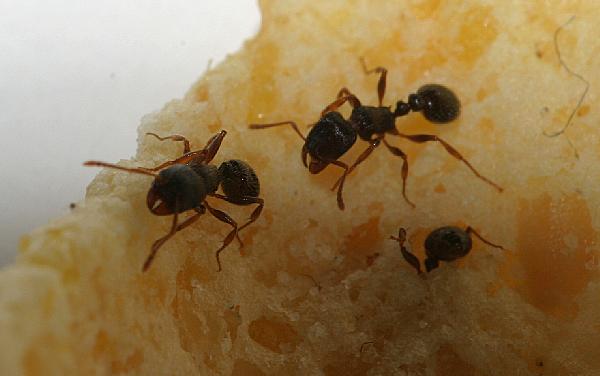
Back on March 23, 2012, I found this Frito corn chip on the floor at work, covered with a few dozen pavement ants. This was in about the same place as I had previously found an ant-covered snack chip, and the ants probably came from either the same nest or a daughter nest[1]. They are most likely the Immigrant Pavement Ants, Tetramorium immigrans
A scorpionfly walks into a bar, and the bartender says, “Hey, buddy, why the long face?”[1]

I found this lying dead on the side of the road on June 26, 2012, and immediately scooped it up to bring home. This is only the second scorpionfly I’ve ever seen, and the first one was years ago, before I started taking bug pictures.
This little midge-like fly came to a light on the night before May 26, 2012, along with a bunch of moths. This was a bit unusual, as I normally don’t see midges being particularly drawn to lights.
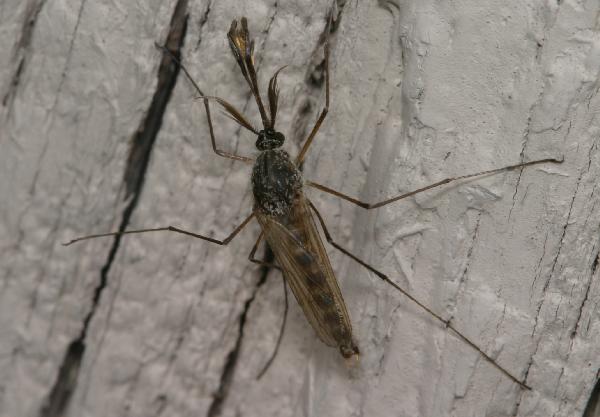
There’s a lot of stuff sticking out of the head. There are a pair of feathery antennae sticking off to the side, but most of it is the hugely elongated maxillae (some of the mouthparts) that are sticking way out in front.
When I left the garage ceiling light on and the door open on the morning of May 19, 2012, the single most common species drawn to the light was lacewings. There were a few dozen of them, all over the ceiling.

If I had doubted that they were common before, I have no doubts now. They really appear to be dominating the aphid-eating niche, I find way more lacewings than lady beetles these days.
We found a number of these black beetles on May 20, 2012. They were in the flowers of the same bush where we found the crab spider posted last time, although not on the exact same bunch of flowers.

They look to me like small scarab beetles (family Scarabaeidae). A good strategy for finding things on BugGuide is to search for a family name plus whatever it is eating, and then scanning the thumbnails until you find something close. So I tried “flower scarab”, and looked for black ones.
The flowers that bloom in the spring (tra la!) breathe promise of . . . sudden death! We found this crab spider lurking around in the fresh blossoms of what I think is a chokecherry bush (Prunus virginiana) on May 20, 2012. To any bees or flies coming to the blossoms looking for nectar or pollen, this would be the biggest (and probably last) surprise of their lives.

She’s another example of our old friend Misumena vatia, the “goldenrod crab spider“. They are very common, and are probably the most common large crab spider that one is likely to find hanging out in blossoms in North America (and maybe in most of Europe and Asia, too, since they are found all around the Northern Hemisphere).

Rosie brought me this large, nearly-black lady beetle on May 18, 2012:

I’m not quite sure where she caught it, but it does make up for the practically identical one last year that she let go before I could photograph it. So anyway, we already have an ID on this one. It is another Fifteen-Spotted Lady Beetle (Anatis labiculata), that is so old that it has darkened to the point that you can only see the spots if you look closely.
Sam caught this for me with her insect net way back on June 11, 2010. So here it is as our Christmas Nymphalid Butterfly[1].

This one is a bit unusual, in that the colors and patterns on the underside of the wings are actually bolder and better defined than on the top side.
I spotted these two beetles mating on our big window on May 25, 2012.

They kept this up for a long time, allowing plenty of time for me to get the camera.
Here are a couple more moths from the night I left the garage light on and the door open (May 19, 2012). First is the one that was perched on the control lines to the garage-door opener:

Like a lot of moths, it was practically comatose in daylight. When I poked it, it fell into my hand.