
This crab spider was on the kitchen counter on July 5[1], strolling along just as bold as you please.

It appears to be a male goldenrod crab spider, Misumena vatia.
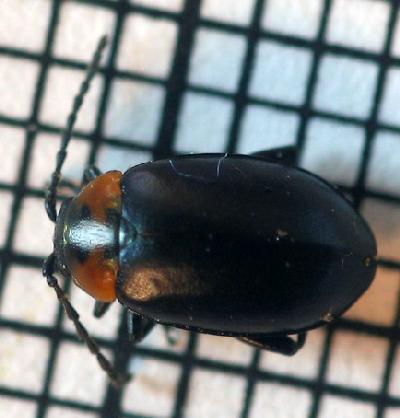
This little beetle was found out back, crawling around in my father-in-law’s hunting blind[1].

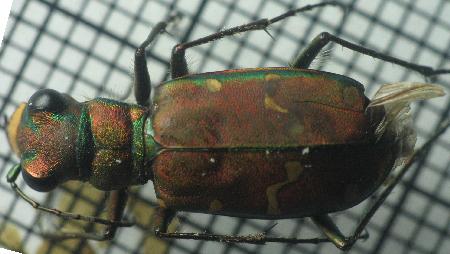
This one looks like a battle-scarred old veteran. I found it near the road, so it is possible that it lost its antenna and fractured a wing cover in an encounter with a passing vehicle[1], not in combat with some predator or prey:
This week we have a bonus bug, courtesy of my daughter
So, while I was finishing off the posting yesterday about the western conifer seed bug, my daughter came charging into the room with something in her hand, announcing “Take picture, Dada! Take picture!”[1] So, I did. This is what she had:
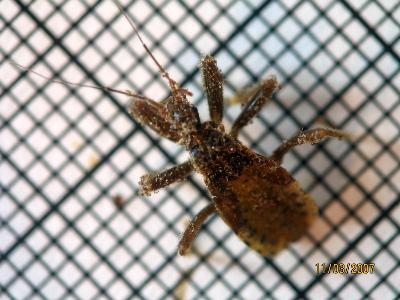
Assassin, or innocent bystander?
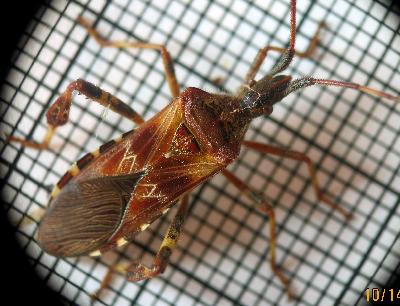
Last week, we had an assassin bug. So, what’s this one? At first glance, it doesn’t look all that much different from the assassin bug, other than coloration[1]. It even looks like it has a neck. If we look closer, though, there is a key feature that gives it away: the middle section of the hind legs (the tibia) is flattened and enlarged, kind of like a leaf.
This one is an assassin bug. It’s actually in the same family (Reduviidae) as the Thread-Legged Bug from last week, but it certainly doesn’t look like it:

Specifically, I think it is Reduvius personatus, commonly known as the “Masked Hunter”.
I’ve never seen one of these before, but I think that’s because they’re hard to spot, not because they’re particularly rare:

This is a “thread-legged bug” that I found in the bottom of the wheelbarrow after moving some old lumber. At first, I thought it was a tiny splinter of wood, before I realized that it seemed to be levitating slightly[1]. The legs are long, thin, and practically invisible, hence the name.
I was picking up apples in the side yard[1], and found this grub burrowing into one.

These are commonly referred to as “wireworms”. Unlike most other insect grubs, they have a hard exoskeleton that makes them remarkably durable. They are hard to crush, hard to pull apart, and all in all have about the consistency of a piece of wire. They do have legs, which you can see above, but they barely use them and for the most part their behavior is quite wormlike.
I hate these soooo much . . .
This is one that, as a hobbyist beekeeper, I am all too familiar with:

This is a varroa mite, Varroa destructor[1]. They are a parasite of honey bees, derived from a parasite of the asiatic honey bee Apis cerana. The asiatic honey bee has established a stable host/parasite relationship with their strain of varroa mites, so the mites don’t wipe out their colonies. Unfortunately, the western honey bee Apis mellifera, the one that most of modern beekeeping is based on, has not established such a relationship, and if left alone these mites will wipe out a normal western honey bee colony within 1-3 years, depending on the climate. These mites got into North America (probably on imported bees, but nobody is quite sure when or where), in the early 1980s, and have come close to wiping out both commercial and hobbyist beekeeping in the US several times since then.
I’m sure everybody has seen these:
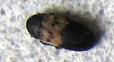
This is obviously a larder beetle, Dermestes lardarius. It is a little fellow, only about half a centimeter long or so. They get into decomposing garbage, stored foods with bad seals, and similar things[1]. Since they find our garbage so appealing, they have been carried by us pretty much around the world.