
On August 18, 2020, Sam told me about this big, weirdly-colored dead grasshopper she had found at the tip of a sprig of goldenrod. So, we went to check it out, and found this:

From the size and shape, I think it is a Carolina Grasshopper, Dissosteira carolina. These are our biggest local grasshoppers, and pretty common. They aren’t normally this color, though. Their normal coloration is either a kind mottled gray that looks like soil, or a brick-red color. The ghastly bone-white color of this one is clearly abnormal.
Sam and Rosie found me this woolly caterpillar on September 15, 2019.
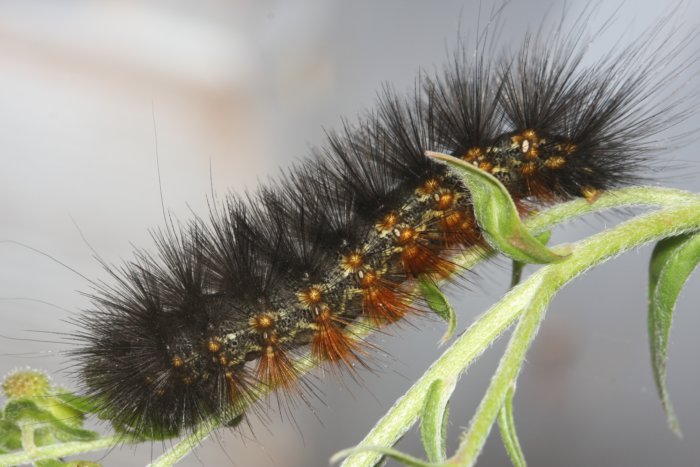
They have gotten cautious about handling hairy caterpillars, because a lot of them have hairs that can get stuck in your skin like tiny, itchy little porcupine quills. So to avoid touching it, they brought back part of the plant it was eating, too. This gives us a nice 2-for-1 post today, with a caterpillar and its host plant.
Sandy found this fat green caterpillar while preparing the garden for winter on October 25, 2019.

As it happens, this was actually the same species as one that I photographed way back in April of 2007. That one was tentatively identified as the caterpillar of the Large Yellow Underwing, Noctua pronuba. At the time I only got one photograph, which didn’t show much in the way of ID features, so it sure looks like time to give it a go again.
Sandy found this brown caterpillar in the garden on June 25, 2019. It was over an inch long, and had clearly overwintered as a partly-grown caterpillar buried in the dirt.
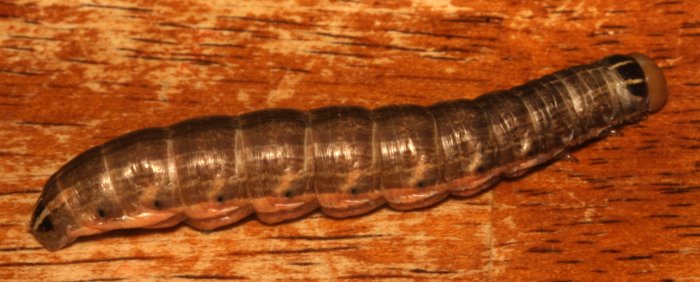
The large tan head, black collar, and three lines starting at the collar and running (although faintly) all the way down to the second black plate at the rear, were distinctive enough that I think I found a match.
OK, this is in the nature of a public service announcement.
Let’s say you have a mosquito problem in your yard. And you go online looking for mosquito traps, to try to catch them and reduce their numbers. And you find that there are dozens, if not hundreds, of these traps available on the market.
But you note that the vast majority of them (and pretty much all of the less-expensive ones) are shown as glowing. Reading in a bit further, we see that they are using light as an attractant.
On July 19, 2019, we spotted this spider on the house siding next to our front door. She had caught a nice big beetle.

When I came in a bit closer to get a better picture, the spider got spooked and dashed off to her hidey-hole, next to her egg sac (that brown, papery-looking object off to her left). You can also see the egg sac in the upper left corner of the first picture.
For some years now, Sandy has been planting milkweed around the house for the Monarch Butterfly caterpillars. This has been very successful, we generally have anywhere from dozens to hundreds of caterpillars taking advantage of them. However, it is good to remember that the name is milkWEED, which means that you had better want them where you planted them, because they are very persistent plants. They also make a lot of seeds. These pictures were taken on November 4, 2020, which was the day the milkweed pods had finally dried enough to pop open and start spreading their seeds around.

Sandy found this spider on the spout of her watering can in the garden on May 23, 2019. He has caught a succulent little fly.

He certainly overwintered as an adult or near adult, since this was pretty early in the season. And I say “he” because his pedipalps, which are holding on to the fly, look enlarged at the ends.
Robber flies generally are flighty little beasts. Normally I don’t even get one good photo before they fly off. In this case, on July 2, 2019, I did manage to get one good shot at least:
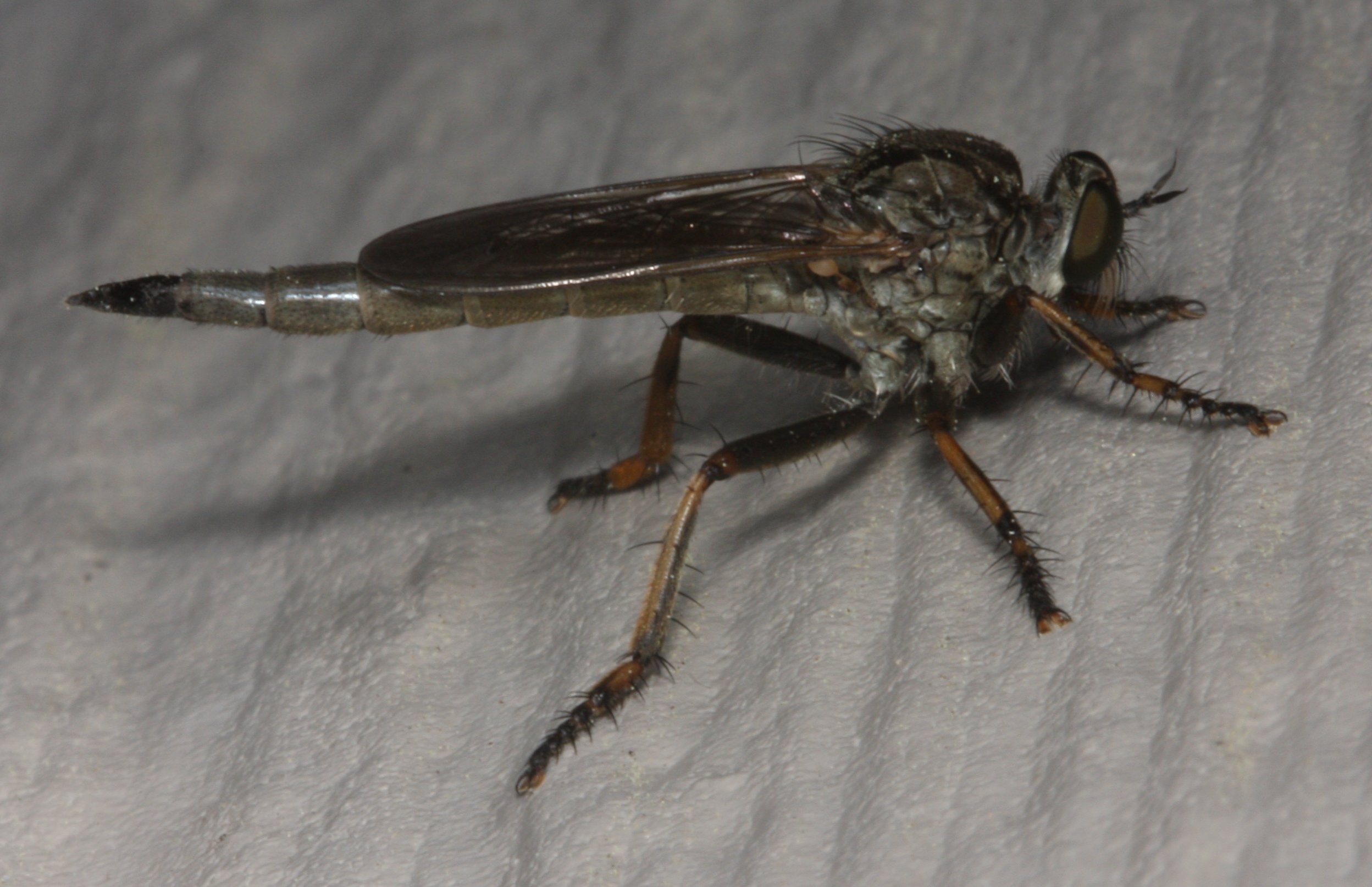
Then a bit over a year later, on July 20, 2020, we found one that was a bit more cooperative. It had fallen into some water, and when we rescued it with a stick it pretty much just stayed still for quite a while. Unfortunately, I had forgotten to reset my lens aperture from using the camera on non-insect subjects, and ended up with a bunch of pictures that were way too blurry to use because of bad depth-of-field. But there were a few that came out kind of OK. Here is the second robber fly from the side, looking a bit bedraggled:
We found this pair of stilt bugs, Neoneides muticus, mating on June 13, 2020. Like a lot of insects, they mate by connecting together at the tip of the abdomen, and then they wander around as a pair for a while.
