
During the first couple of weeks of June, I kept seeing these good-sized insects (nearly an inch long) fluttering along over the road that we live on. And on June 15, 2021, I finally caught one. Well, not “caught”, exactly. OK, it had landed on the road and died, so all I had to do was pick it up. Anyway, here it is:

Here’s a small brown moth that was at our porch light on June 25, 2019.

It looks like a Tortricid moth. This is a large family of smallish moths that mostly seem to have caterpillars that are “leaf-rollers”, rolling themselves up in a leaf like a burrito so that they will be protected while they eat it.
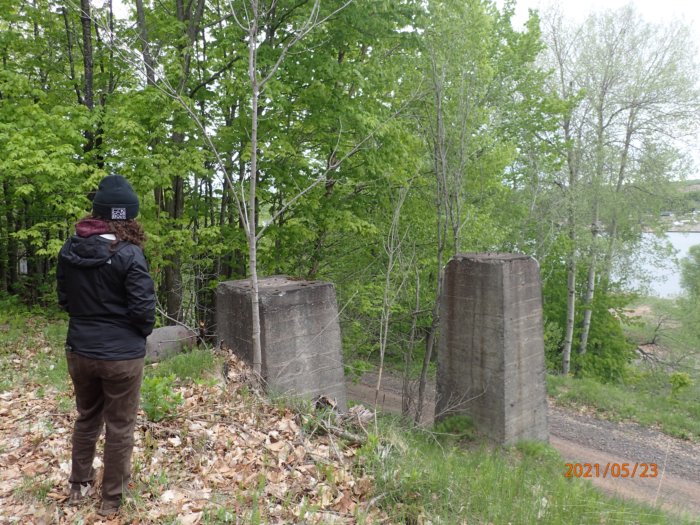
This is a bit of a break from plants and animals. Instead, we will be looking at an odd, unidentified structure my family and I stumbled across while out for a walk on May 23, 2021. At the bottom of the hill we live on, there is a trail that was formerly a railroad, but the tracks have been taken up and it was converted to a snowmobile/ATV trail. At the point where the trail crosses our road, there are concrete pylons that used to hold up a railroad bridge that crossed the creek valley.
I was on an expedition to find the remains of two former manganese mines[1] on May 20, 2021. And while driving down a dirt road near Alberta, I passed several patches of these very attractive and distinctive white flowers.

This sawfly came to our porch light on June 9, 2020.

Sawflies are broadly related to wasps, but they don’t have stingers. Their caterpillars generally eat leaves the way moth caterpillars do, and the adults generally look like this with fairly stocky bodies and kind of wasp-like heads.
Continuing our run of male spiders, this male crab spider was on our house siding on June 17, 2020.

Again, he’s definitely male, as we can see from his very large boxing-glove-like pedipalps sticking out in front.
We are on something of a run of male spiders, I guess. This one was on our windowsill near the potted plants on October 19, 2020.

Like so many other spiders we find, he’s missing a leg. I guess if anyone wants to know why spiders have eight legs, it looks like the answer is “so that they can lose a bunch of them and still get around.”
This leggy male spider was on our house siding on June 9, 2020.
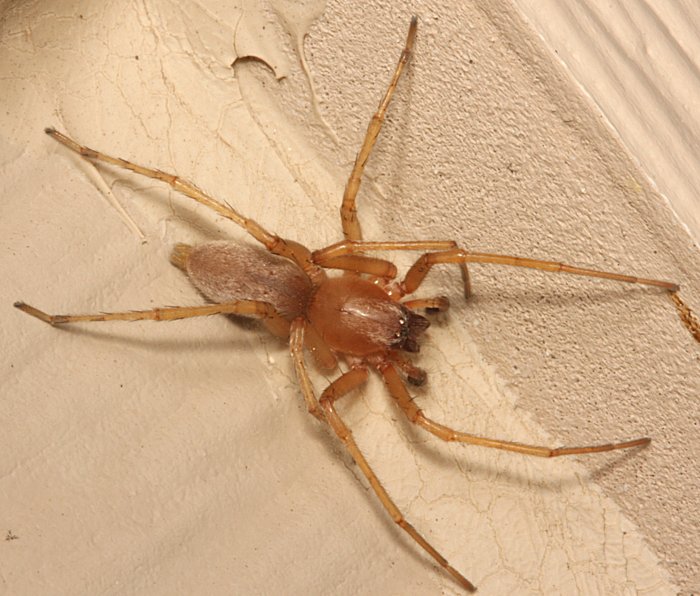
I can tell he’s a male because his pedipalps have enlarged tips, which is characteristic of male spiders.
This almost shockingly orange little moth came to our porch light on July 5, 2020.

It is one of the tortricid moths, which are smallish moths with this particular round-shouldered shape. Specifically, I am pretty sure it is the Lesser All-Green Leafroller, Argyrotaenia quadrifasciana
This rather striking little moth came to our porch light on July 5, 2020. Its brassy metallic sheen was pretty eye-catching.

It was only about half an inch long and very thin, so pretty small as moths go. The antennae have white tips, and the legs have spikes sticking out of the joints.