While we were camping at Traverse City on June 18, Sandy found this big black beetle trundling about[1]. It was pretty big, the body was around an inch long (about the size of the first joint of my thumb).

On our trip downstate, we stopped by to visit Sandy’s brother in Whitmore Lake on June 15, 2016. There was a little park just down the street from his house, and while we were walking down there with the girls, somebody noticed that one of the houses had something unusual in their yard. At first we thought it was a lawn ornament, but then realized that it was actually a pretty big turtle. Not wanting to be trespassers, Sandy and Sam went up to the house, rang the bell, and when the owner came to the door asked him, “Can we come into your yard to look at the turtle there?”
He looked rather taken aback by this question. “The what?”
We took a trip to southern Michigan and part of Ohio from June 14 to June 22, 2016, and on our way back we stopped to visit the Grand Traverse Butterfly House and Insect Zoo[1], which is just outside of Traverse City
The butterfly house portion is a simulated tropical rainforest, with a nice waterfall and flowers everywhere.
On the evening of June 11, 2016, I was driving our little pickup truck back home along Canal Road, and kind of casually noticed what looked like a rock beside the road. And as I passed it, suddenly realized, “Hey, that rock looked like it had a head! And a tail!” So, I immediately pulled over, ran back, and saw this fine individual getting ready to unintentionally commit suicide by trying to cross a busy road:

There are a number of species of small crane flies (about half an inch long) that are commonly found flying around even when the temperatures are barely above freezing. Here are some of them from November 5[1], 2015.

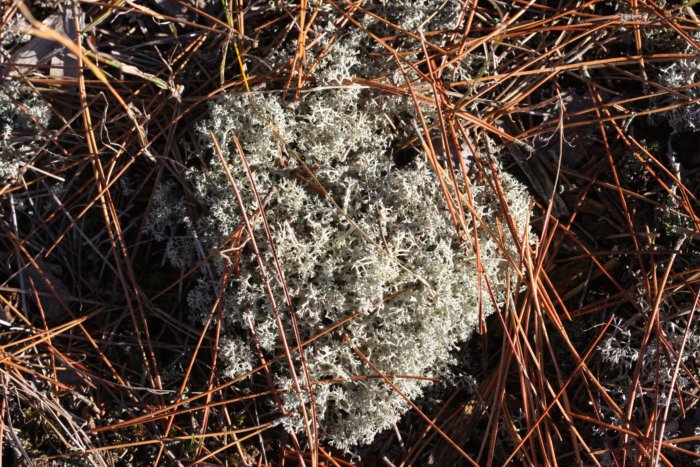
On patches of nutrient-poor soil where nothing much else grows, we have extensive areas of this very hardy “plant”. It is Reindeer Moss, Cladonia rangiferina, one of our most cold-hardy types of vegetation.
On December 12, 2015, we received a Christmas card with this charming little passenger riding on it:

Granted, December of 2015 was unusually warm, but still. It had been below freezing most of the time for a couple of weeks at that point. This is one cold-hardy spider, and they must be loaded with antifreeze to keep active at low temperatures like this.
This inchworm was out really late in the year, it was crawling on our house siding on November 4, 2015. This was well after our first frosts, which happened a couple of weeks earlier.
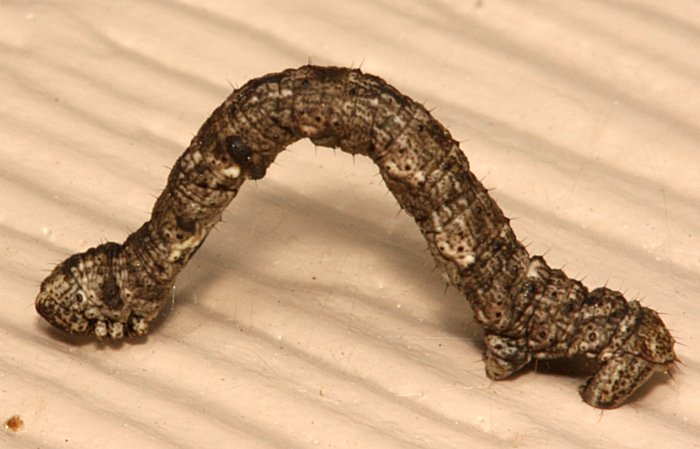
If it was going to overwinter as a pupa, I would have expected it to have made a cocoon already. So it was probably going to overwinter as a caterpillar. and was crawling on our house siding looking for something to shelter under.
In addition to the Common Horsetails, we also have quite a number of their close relatives, the Scouring Rushes. There are two species of scouring rushes growing alongside of our road: one with stems about the diameter of a pencil and that get almost 3 feet tall:

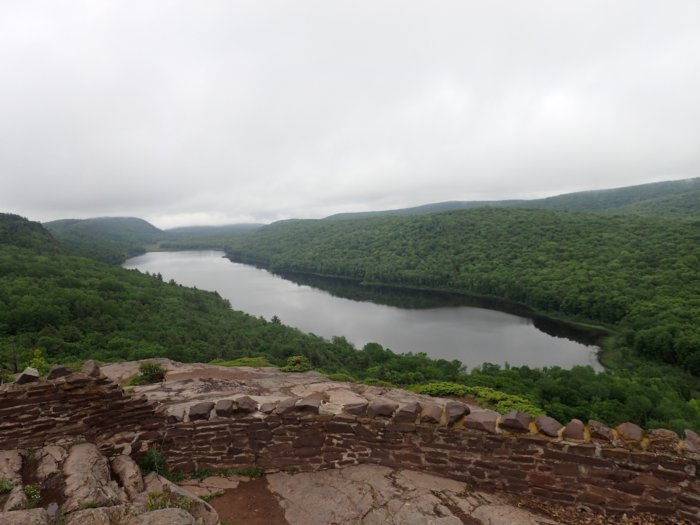
We took a day trip down to the Porcupine Mountains[1] to see the Lake of the Clouds on June 14, 2015, just to see what we could see. This is the view from the cliffs overlooking the lake, a few hundred feet up.