These plants grow in great profusion in and beside the little stream that flows alongside of the road that we live on. I photographed them on May 11, 2016, while they were still showing their two distinct types of shoots. The first part to come up are the brown-and-black spore-bearing shoots, which are up to about 6 inches tall. These pop up practically overnight, and have no leaves or chlorophyll.

Sam and Rosie caught this little frog in the yard on April 16, 2016.

Its body was under an inch long, so as far as size goes it wasn’t much bigger than some of our larger insects. From the coloration, and the dark “X” mark on its back, this is pretty clearly a Spring Peeper, Pseudacris crucifer.
In addition to the pines and balsam firs, the next most prominent conifers on and around our properties are the spruces. We have some big ones near the barn that I think were planted intentionally:

and smaller ones scattered around the property that came up from seed.
This particular species of mostly-white moth comes to our porch light fairly regularly in late summer, but up until now I haven’t had a page devoted specifically to it (although I did have it share a posting with one of its relatives back in 2011). This one is from August 4, 2015.

I think it was Rosie that spotted this spider in the house on October 4, 2015.

It appears to be a funnel-web weaver, most likely one of the ones in the common genus Agelenopsis. These look superficially like a lot of wolf spider species, but they have projecting spinnerettes (the two projections on the tip of the abdomen).
Today, instead of insects or plants, we have – a bucket of snakes!

The girls found these on July 8, 2015. They aren’t actually that big, the largest was only about 6 inches long. They are about the size of the really big “nightcrawler” earthworms.
Back in June of 2015, we went to the local cricket dealer to get crickets to feed to our tarantulas. Now, just selling crickets is no way to make a living, the demand just isn’t there, so she was also selling a variety of other things for people to feed to their carnivorous pets. One of those items that caught Sam and Rosie’s eyes were these Superworms (Zophobas morio), which are really big beetle larvae. As you can see by comparing this one with the ruler, it is well over an inch long.

Here’s a tree that may well be easier to identify in the winter (when it has no leaves) than in the summer. It is Paper Birch, Betula papyrifera, which is one of Northern Michigan’s signature trees.

This moth came to our porch light right at the end of our moth season, on November 5, 2015. It is a fairly uniform pale brown, almost blonde.

The thing is, we have very few local moth species that are both this size and that also fly as late as November, and this moth doesn’t quite look like any of them.
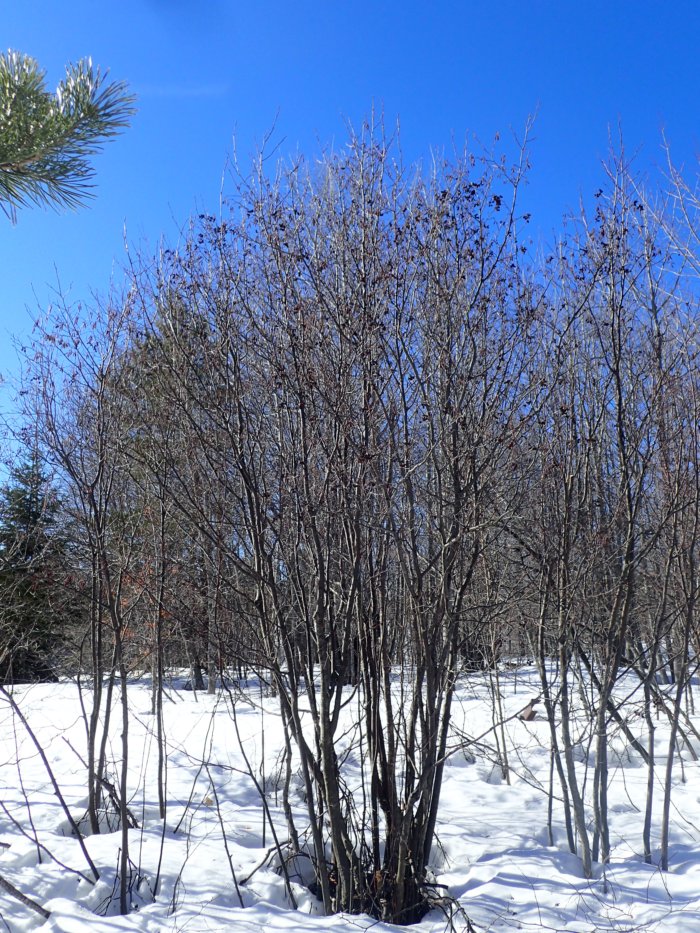
There are clumps of these shrubs all over our property. They are alders, genus Alnus, which are moderately closely related to birch. Ours only get about ten feet tall.