I’ve put off posting this tortricid moth from May 18, 2015 because I wasn’t sure that I’d be able to narrow it down very far. It has one of the common Tortricidae body shapes, but this is a very speciose family, and the lack of distinct color features was not very promising. Incidentally, it looks kind of blurry in this picture, not because it was out of focus, but because it actually looks blurry in real life.

This tall tree with a symmetrical top is a good landmark in our back yard, as it stands right in the middle where it is clearly visible from all the places that are out of sight of the house. It stands probably 35 feet tall, and has no other similar trees close to it. I took this picture on March 12, 2016, but being an evergreen conifer it looks pretty much the same all year.

Sandy found this tiny beetle on an orange in our kitchen on October 29, 2015. It was so small that it was actually getting kind of hard to see. We don’t know if it is a local species that got into the house, or an “exotic” that got carried all the way to us from wherever the oranges were grown. This possibility really opens things up, because there are probably more beetle species on any given square mile of Florida orange grove than there are in the entire Upper Peninsula of Michigan.

Red pines, like this one, are the dominant trees in the back part of our property.

The reason that they are dominant, is that right behind our property is a couple of square miles of land that is mostly covered with a pine plantation, and this is the species of pine that the owners planted. The land west of our property currently looks like this:
This moth was at the light on August 4, 2015. Again, its general appearance screams “some kind of cutworm or dart moth”.

After searching, I found something that has pretty much exactly the same pattern, although mine’s patterning is not as clear and distinct. It looks like a somewhat faded Subgothic Dart Moth, Feltia subgothica.
It was a nice, sunny day on March 12, 2016, so I strapped on my snowshoes and went out to take pictures of trees. This first one is one of several white pines (Pinus strobus) that we have growing around the place. None of ours are particulary large, because up until about 50 years ago our property was mostly potato fields, but white pines can get really huge given sufficient time. They are apparently the tallest native tree in eastern North America, and it is claimed that some of the original old-growth White Pines were over 200 feet tall.

I was in Phoenix, Arizona the week of February 21, 2016 for a technical conference, and found these interesting arthropods just outside the convention center
The first one I saw was this stick insect, that has interesting shoes. Very stylish.

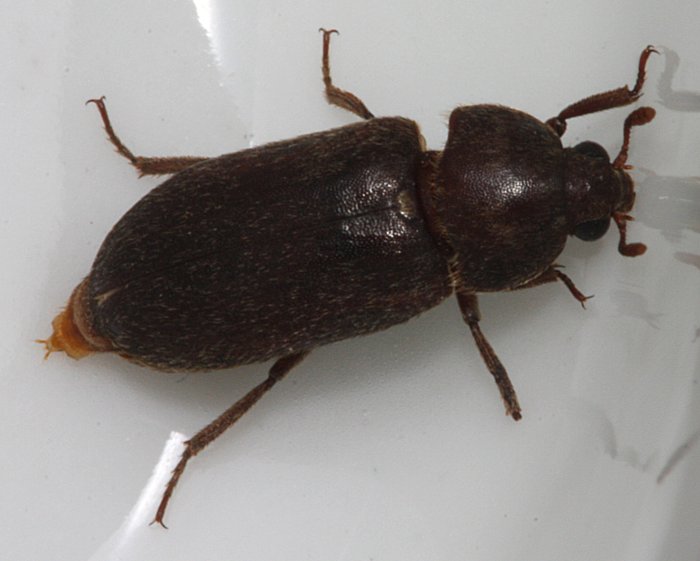
Sandy found several of these quarter-inch beetles living in the cage that she keeps crickets in to feed the tarantulas. This particular specimen was from October 31, 2015, but we found them from time to time through February as well.
I photographed this clump of intensely green (almost fluorescent) moss in the stream beside our road on June 15, 2015. It was not immersed in the water, but was growing on a little gravel island in the middle of the stream. The clump was about the size of the palm of my hand.

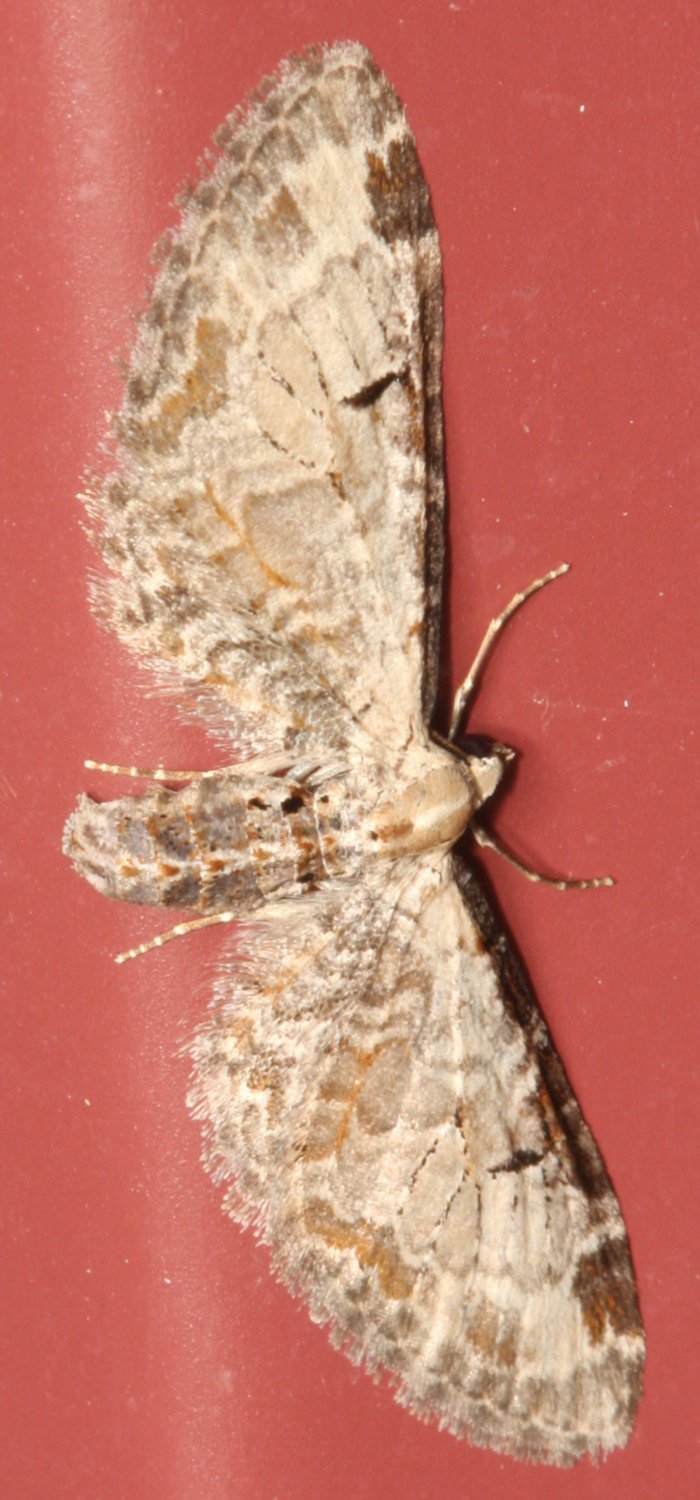
Here’s yet another moth from our porch light on May 18, 2015. All my pictures of it turned out to be from the same angle, but this one does seem to show pretty much all the details one would reasonably expect to be able to see in a picture. Especially considering that the actual moth had a total wingspan of around 3/4 inch, and so (depending on how big your screen is) this picture is pretty close to 20 times actual size.