
Here’s a moth that came to our porch light on August 1, 2010. In reality it was pretty tiny, maybe half an inch long, but that doesn’t mean I can’t blow it up to monstrous dimensions for your viewing pleasure:

This moth was drawn to our porch light on August 1, 2010, and obligingly hung out on our house siding.

This looks to me like a Sparganothis Fruitworm moth, Sparganothis sulfureana. These have the right shape, are often that particular shade of yellow, and have that dark “X” pattern running across the backs of the wings.
When Sandy goes out ice-fishing, she likes to use “waxworms”, which all of the local bait shops carry. They are these creamy-white caterpillars, about 2 cm long. Here’s one in Sam’s hand, that was left over from a fishing trip on January 15, 2012:

Back around the end of September 2011, while I was at work, this moth flew into my office and died[1]. It was pretty large and striking, and I saw it come in. But, when I tried to catch it, it flew behind some bookshelves and I lost it. It wasn’t until some weeks later that I moved a stack of books, and found its dried-out corpse lying there by pure luck. So I brought it home to photograph.

Back in the June 13 posting about rat lice, I closed with this:
“And in the future, any time that we get a new pet, you can bet we are going to check them over for lice first thing.”
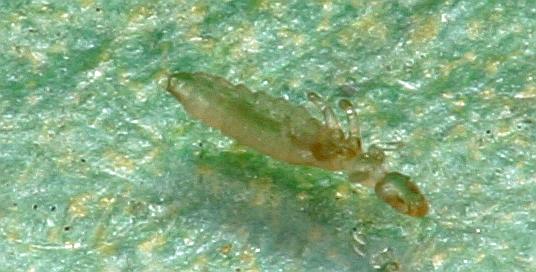
Well, after the last rat died of old age a while back, Sam ran a family vote on what the next small-animal pet was going to be, and we settled on a guinea pig. We found some really cute young guinea pigs at the local pet shop, brought one home, and started looking him over. There was nothing immediately obvious to the eye, but when we combed him with our steel “nit comb”, there were a couple of tiny little white objects. They were a bit smaller than the commas in an average printed text, and they moved pretty briskly.
I happened to have my camera with me when I went to work[1] on July 26, 2011, and spotted this little fly on the wall in the little room between the outer and inner entrance doors[2]. It was just a touch bigger than the average mosquito, at maybe 7-8 mm long.

Sam spotted this good-sized grasshopper (about an inch long) on our garage floor on July 31, 2011. It wasn’t dead, but it was pretty calm and just sat there while I took pictures.

It’s face has a fairly pronounced forward slant (projecting forehead), which is consistent with it being one of the Slant-Faced Grasshoppers, subfamily Gomphocerinae. It has wings (which makes me pretty sure it’s an adult), but the wings are far too small to support it in flight. There are a number of grasshopper species with short wings like this. Sometimes it is only one sex with short wings, sometimes it is both, and sometimes they have varying forms within the species, with some having short wings and some having long ones.
Sam and I found this grasshopper on the foundation of our house on September 6, 2010.

I’ve had a picture of this species on this site before; it’s a Two-Striped Grasshopper, Melanoplus bivittatus. This time we can see the two white stripes that give it its name. The stripes start behind each eye, run more or less parallel down the back, and then merge together about halfway down the length of the wings.
Just a few days ago, on August 1, 2012, I was bicycling home as usual, cruising along and talking to myself[1], when suddenly, as I was inhaling, an insect got sucked into my mouth, smacked into the back of my throat, and stung me in my right tonsil[2]. Yow![3] So I jammed on the brakes[4] and juddered to a halt, coughing and hacking, until I finally horked up this sad, phlegm-coated insect. She looked dead. Obviously, the most critical thing I had to do at that point was make sure I could get her home for pictures[5]. So I popped her in one of the little insect bottles I almost always carry these days, took her home, and gave her a rinse with tap water before putting her on a piece of paper towel in a dish to dry out overnight. She still looked dead at that point. Rather shockingly, she turned out not to be dead; the next morning, she had woken up, cleaned herself off, and looked as fit as if she had never been violently jammed down my throat in the first place!

She was logy at first, but the camera flash made her perk up and start moving around.
Sometimes “dust bunnies” are just dust bunnies. Other times, though, they move. Like this one, for example: we found this moving lint speck on the garage floor on August 22, 2010.

It was just a little guy, only a few millimeters long, covered with random dirt (the gray and brown stuff) and sawdust from our table saw (the white, splintery-looking stuff). This is at pretty high magnification, in real life it just looked like a tiny ball of dust. With antennae.