
Sandy found this fairly large, mostly-red stinkbug nymph on June 27, 2010. It was over a centimeter long (just about half an inch).

This is broadly similar to some predatory stink bug nymphs that I posted previously, but differing quite a lot in detail, with the colors being mostly brown, red, and dark metallic green.
I was originally going to run something different today, but then I was informed that this week is National Moth Week!. Well, I can’t very well go this week without a moth, then, can I? What’s more, it should be a good one. So here goes!
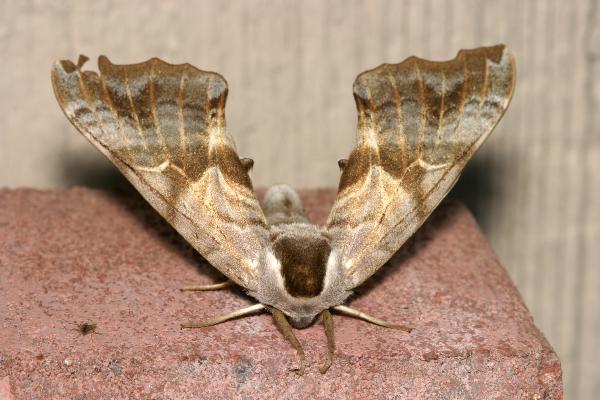
We found this on a tomato plant on August 6, 2010.

It’s another female katydid, like the one I posted way back in September 2007. These pictures are a bit better than my previous attempt, though, so I thought it was worth posting this species again.
I was out sweeping an insect net through the new grass on May 15, 2010, and this attractive little maroon-and-white spider was one of the things I found in it. The insect net has 8 mesh openings per centimeter, and its body is four mesh openings long, so it is only 5 mm, which is medium-to-small as spiders go.

There are quite a number of medium-sized brown crab spiders about, we regularly find them on flowers, on the side of the house, hiding in crevices, and similar places. Like this one, that we found on the kids’ plastic slide in the yard in the spring, on May 30, 2010:

The fact that she was so big so early in the year is a pretty clear indication that she overwintered as a nearly-mature adult. She probably spent the winter in the “subnivean environment”, the thin layer between the snow and the soil where it isn’t quite freezing, and the grass props up the snow enough that creatures down there can move around.
I’ve got two moths this time, both the same species but photographed a couple of years apart. First up is one we saw through the window glass on July 31, 2010. Unfortunately, these are very flighty moths, so when I tried to go outside to get pictures of it from the other side, it flew off. So, for a while now all I’ve had were these pictures of its underside.

Here’s a porch light moth from almost exactly a year ago (July 3, 2011). From the pose, the size, and the kind of wavy dark patterning on the wings, I think this is one of the Zales[1], a large genus of common moths.

I photographed this one trying to hide its head under our house siding on August 1, 2010.
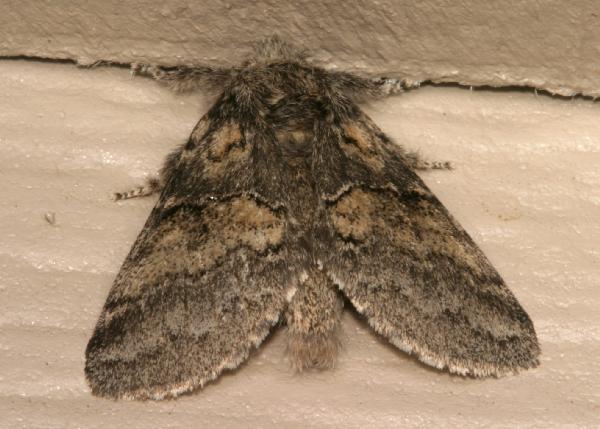
Eventually, I got it to flutter down to a patch of concrete where I could get pictures that included the head, with the big feathery antennae making it fairly clear that it was a male:
I’ve been accumulating pictures of tiny little moths for a while now. And, as I’ve noted in the past, these little guys are pretty numerous and really hard to get good IDs on. So, this post is devoted to all the little moths that I don’t have many good pictures of, don’t know what their caterpillars were like, and probably won’t be able to identify beyond the family.
Well, OK, maybe I have an idea of what this first one is, that I photographed on April 27, 2010. It looks like an Aspen Leaf Blotch Miner Moth, but the only reason I know this is because I raised one up from a larva once, so I knew what its food plant was. And we have a lot of aspen trees around the house that were heavily infested with leaf miners that year.

There were actually a couple of these good-sized brown moths on our siding near the porch light on August 1, 2010. The first one was positioned where I could get a dorsal shot,

while the second one was visible from the side.