
It squeaks!
Here’s a beetle Sam found on the side of the house on June 27, 2011. She thought it was a bird dropping at first until it moved, and now she calls it a “Poo beetle”.

From the elongated snout, it is clearly one of the snout beetles in the family Curculionidae, and I think it is a “Poplar and Willow Borer”, Cryptorhynchus lapathi.
Sam found this one walking across our sidewalk in front of the house on May 21, 2011. It was almost 1 cm long, slow-moving, heavily-armored, and would tuck itself into a neat little ball when disturbed.
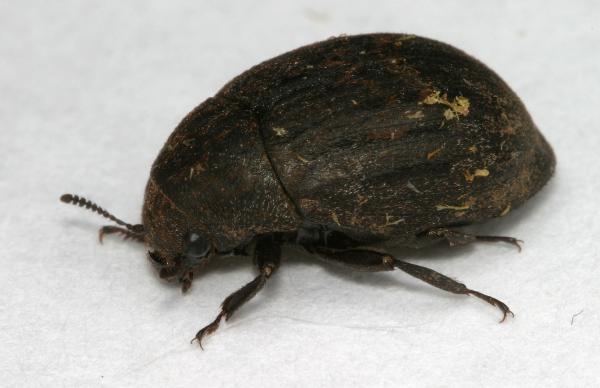
I thought at first it was some kind of scarab beetle, but scarab beetles have complex antennae that split into multiple “fingers” at the tips, while this one had simple, “beaded” antennae.
So, I was bicycling home on May 21, 2011 when I suddenly caught a swarm of these little guys in the face. I tagged this as “Found in Teeth” because I had to spit out two or three of them afterwards, but those weren’t in any shape to photograph. I caught this one by going back to the swarm (which quickly reformed itself) and waving a small jar around until I snagged one.

Sandy found this large, active beetle larva under a rock in the garden on June 4, 2011. It was pretty big at about 3 cm long, but skinny and not enormous. Sam found two more a few days later, so they are certainly very common. It ran and ran and ran, so to have half a chance of getting a picture I put it in a little ceramic dish [1], where it could run around but couldn’t climb the sides.

On May 28, 2011, our 3-year-old daughter Rosie came into the house after playing in the back yard, trotted up to me, and proudly held out her arms – which were covered with at least a hundred (no exaggeration) of these tiny (2-3 mm long) black ants:

We found this beetle on July 31, 2010 on the side of the house.

It was very similar to this one that I posted back in May 2009, but not identical: the previous one had a stronger metallic color, a slightly differently-shaped head and pronotum (the plate just behind the head), and looks to have a different pattern of sculpturing on the face.
Goldenrod is very common on our property, with several large patches of hundreds of plants each. And, if one examines the goldenrod stems, a lot of them will have these nearly spherical galls about an inch in diameter:

I cut one open last summer in mid-July to get a picture of what was inside. The gall was mostly solid, but in a little pocket in the middle we found this little grub:

Sam found this little (only about 5 mm long) beetle for me on May 21, 2011 (Yes! It is from this year!). It was determined to make life difficult for me by running around, so this is the best shot I could get while it was upright.

Once upside down, it seemed more or less resigned to its fate, so I could at least get pictures of the underside.

Sam and I were turning over rocks on August 1, 2010 and found this fine, large beetle. Those are my fingers it is crawling over, which makes it about an inch (2.5 cm) long.

It is very similar to a beetle that I previously posted back in 2007, and tenatively identified as Calosoma calidum (although, I see that it has evidently been renamed Callisthenes calidus since then). Except, that one had distinct gold-colored dimples on its wing covers, while this one has very little coloration in the dimples. At first, that made me think that what we had here was the related Calosoma frigidum.
We found this in the yard almost exactly a year ago, on June 21, 2010. It was 13 mm long, a pretty fast runner, and has a lean, predatory sort of look.

The body shape, head shape, and slight iridescence lead me to it being one of the Carabids. This is a very large family of mostly carnivorous beetles, that tend to be active hunters of things like caterpillars, snails, worms, and other insects.