
Here’s another beetle that the girls caught for me when we went to Otter Lake on May 22, 2010. This is a pretty good sized weevil, almost a centimeter long, which is positively huge as weevils go around here. She’s had a rough life – in addition to missing part of her left foreleg, she also doesn’t have any antennae anymore.

Caterpillars with pink and white stripes
Sam and I found two of these while turning over pieces of dead log on June 14 of 2010 (almost exactly a year ago).

They looked big enough to be ready to pupate, so we tried rearing them in a jar. Unfortunately, they died (possibly because we didn’t know their correct foodplant) so we never did get to see the adult form.
Last week, Alex Wild brought up the topic of Longform Photoblogging – his was a rather long mayfly. Well, in that spirit, here is my contribution to the longform format:

On occasion, we leave the front porch light on during the night, and then go out in the morning to see what was attracted to it. This is one of the moths that came on August 1, 2010. I was particularly struck by its bulging forelegs that it stuck out in front, as if it were prostrating itself:

Sam found this for me in the yard somewhere on July 21, 2010[1]. It was a small green inchworm, only a bit over an inch long and very thin. The background in these photos is a kleenex, by the way.

In October of 2010, Sam and Rosie won a giant pumpkin in a raffle, which we carved and put out on Halloween. Afterwards, Sandy wheeled it out back to the edge of the woods for the deer to eat. Which they did over a period of several days, starting with ripping its face off:

We caught this beetle in the back yard on July 31, 2010. I can’t remember now whether we caught it with a sweep-net in the grass, or whether it was one of the ones that we collected by putting a tarp under a small tree and then whacking the tree with a stick. Both of which methods are very productive for collecting lots of insects, by the way. It is clearly a lady beetle, it has the standard lady beetle body shape and general coloration. Although it was a bit larger than the average lady beetle, probably twice the length of the standard little orange-with-black-spots types[1].

Sam found this small, brightly-colored beetle on a window screen on July 24, 2010. He was only about four millimeters long (the thing he is standing on is the lip of a plastic jar that is about 2 mm thick) but the red-orange coloration was fairly eye-catching.

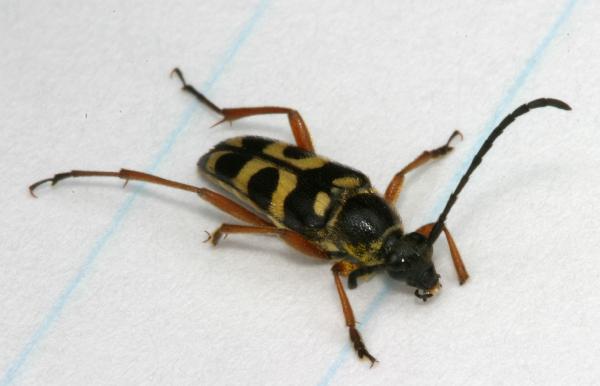
When Sam caught this beetle in July of 2010, I just took the pictures for the sake of the practice, because I though that it was one that had already been photographed and posted on this site. But, on further examination, I see that aside from both being black beetles with yellow markings, they were not otherwise very similar. The other one had very thin, sharply curved yellow markings, while this one has broad yellow stripes, with the middle stripes joining to make a kind of “U” mark on each wing cover.
A special Easter bonus posting. Two postings in one weekend! Plus snow!
Early yesterday morning (Saturday, April 23, 2011), we had what I sincerely hope was our last serious snowfall of the season [1] . We got a couple of inches by about 7:30 AM, when I went outside to get the saturday newspaper.

Once outside, I noticed that there were a number of what looked like short twigs resting on top of the snow. Then I thought, “That’s odd – there’s no wind to break twigs off of trees, and it’s still snowing. Why would twigs be on top of the snow?” And looking closer, I realized that the answer was, “Because they aren’t twigs”.

They were, in fact, earthworms! Little earthworms, only a few millimeters in diameter and a couple of inches long, but earthworms nevertheless. What they were doing crawling around in the snow, I have no idea. They were certainly alive, too. When I picked one up, it curled up and contracted just like you expect a worm to do.