
And now, for our 200th installment, we visit these ladies that we’ve seen before. They are Northern Paper Wasps, Polistes fuscatus. But this time, there was a nest built in the eaves of our house that was in a very convenient spot for photographing. So, let’s have a look at the nest:

In the backyard near the strawberry patch, we have a free-standing iron plant-hanger. A tiny little yellow orb-weaver spider used it as a support for a tiny little orb web, about two inches across:

I expect it was a recently-hatched spider, with a body maybe one or two millimeters long. These pictures show the virtues of an orb web. First of all, it uses a bare minimum of silk to cover an area much bigger than the spider, and she can dash quickly to any part of it when a prey item hits it. Second, the spiral strands are sticky (so that little midges that hit them will adhere), while the straight strands running out from the center are not (so that the spider can run along them without getting stuck herself). And third, it can be really hard to see. That first picture was angled so that the light would reflect off of it, but if we change the angle just a little, it is a case of now you see it, and now you don’t:
Back when we were crayfish-hunting in the middle of May, we also caught this by accident while turning over stones looking for crayfish:

On October 31, we suddenly noticed what looked like a very large bumblebee buzzing around the house[1].

It certainly acted like a bee, it was strongly attracted to sweets in any case. Once it settled down[2], we could get a better look at it and determined that it was a young female[3]. But, it was not in fact a bee, but instead some other species mimicking a bee.
I found this huge mayfly hanging on the side of one of the campus buildings on June 22, near where I park my bike. This was only about 50 feet from Portage Lake, so that’s probably where it came from.

The body proper is a bit over 3 cm long, and if you include the tail filaments it is almost 7 cm, which for a mayfly is pretty big.
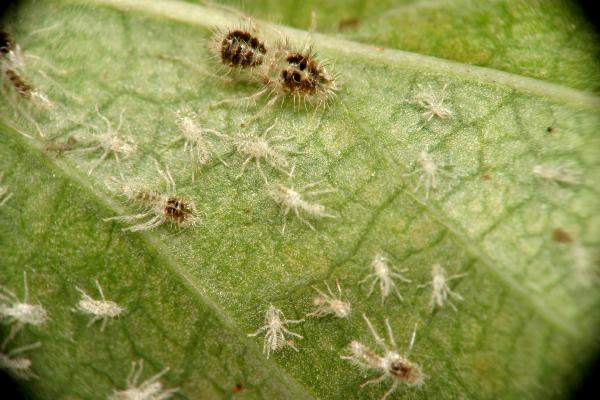
We were invited to a picnic on July 3, and our hosts mentioned that their cherry tree had an infestation of something that looked like tiny spiders. So, I went and looked at it, and saw that practically every leaf was covered with these tiny bugs:
At the beginning of June, we all went down to the little pond on Springbrook Lane looking for tadpoles to raise into frogs. We didn’t find any, but we did find some other stuff, including this rather aggressive-looking individual:

Sam caught this for me on August 8. I think she said it was on the outside of a window trying to get in. Anyway, it is a very large, striking crane fly with a wingspan of well over an inch. It’s unfortunately missing half of its legs, but that’s just the way things go with crane flies[1].

Every fall, thousands of these large, slow-moving, kind of nondescript flies appear in clusters on the siding of all of our buildings, trying to find a way in to any crevice that they can.

They aren’t really after anything, other than a place to hibernate for the winter. Once they find a spot, they settle in until spring, at which point they once again appear in large numbers as they emerge, mate, and fly off.
I found this beetle in the bare ground next to our garage on August 10. It is similar, but not identical, to some that we found eating a dead mouse about three years ago:
