
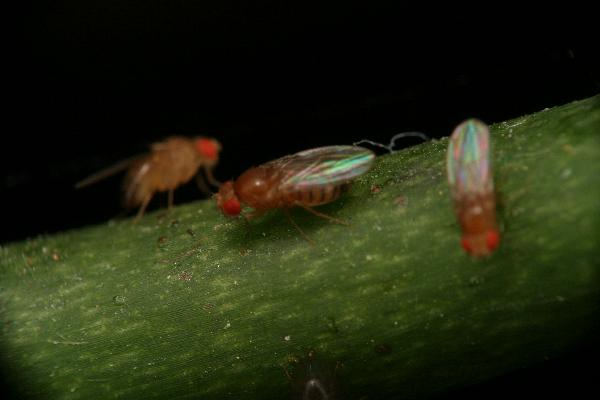
Often called “Fruit Flies”, but real fruit flies are something else, so “Vinegar Flies” avoids confusion
Pretty much every year, around tomato harvesting time, we get some problems with these. Mainly because we end up with a lot more tomatoes than we can eat kind of stacked up in the kitchen, and it only takes one of them getting infested by these gals to pretty much fill the kitchen with hundreds of tiny little flies. For some reason, this year they particularly liked to hang out on the potted orchid in the kitchen:
“If it doesn’t say Sunkist, you don’t know what you’re getting“[1]
Sam and I were out in the yard next to the herb garden, when Sam said, “Look, caterpillar poop!” and pointed at the sage patch. Sure enough, there were caterpillar droppings on the sage leaves, and looking a bit closer we found a good-sized, nearly featureless green inchworm eating the sage. I thought this was unusual, because nothing local seems to eat sage. So, to try to identify it we brought it in and put it into a jar with some sage leaves, to try to raise it to adulthood. And, like a fool, I didn’t photograph it right away. Next thing we knew, it spun a cocoon,

Around June 6, S_ noted that one of our small plum trees [1] had a significant infestation of these scale insects:

Yes, I know that they don’t look much like insects, but trust me on this. I think they are probably one of the Lecanium Scales, possibly European Fruit Lecanium Scale, Parthenolecanium corni. Which, in spite of the name, actually seem to be a native North American species that is also found in Europe. It isn’t clear to me whether they were transported to Europe early on, and then found there before an entomologist described them here, or whether they were always present all around the northern hemisphere.
This was a good year locally for Monarch butterflies. We have a lot of milkweed growing around the place, and in particular there is a smooth-leaved variety growing back in the woods that the Monarchs really like. Around the middle of July, it was to the point that practically every milkweed plant had at least one Monarch egg on it, and the young caterpillars were everywhere[1].

Way back in April of 2007, I had pictures of a dead Green Lacewing that we found in an old spider web. These pictures had some serious deficiencies: (1) I hadn’t learned how to steady the camera or get good magnification yet, and (2) The lacewing was long dead, dried up, and had probably had its juices sucked out by the spider that owned the web we found it in. So, let’s try this again. Here’s one we found on August 1, fluttering around a porch light during the night:

When we pulled our barbecue out in the middle of July, we found this mud nest partially constructed inside of it. Since it was going to be killed anyway by the heat when we used the grill, I carefully removed it so that we could get a better look, and see what was inside.

Chokecherries are a common small tree around here. They have edible[1] fruit that ripens right around the beginning of August, consisting of berries about the size of peas. At least, most of them are the size of peas. Sometimes, while they are still green, a few of the berries become enlarged and distorted. If you cut open one of these enlarged fruits, this is what is inside of them:

The little orange maggots inside evidently eat away the developing seed, and irritate the plant cells to force them to form a gall instead of a proper fruit, with a hollow inside that fills with fluid. It looks like they drink this fluid and get their nutrition from it.
In all the previous jumping spider pictures I’ve put up, I’ve muttered about the near impossibility of identifying them to species without an expert with a microscope. Well, I’m not going to make that complaint this time!

I found this large green dragonfly resting undamaged by the side of the road as I was pushing my bike up the hill on June 16. It wasn’t dead, but it was obviously dying of unspecified causes[1], as it let me pick it up with no more response than a slow motion of the legs and a slight vibration of the wings.

Moth Reared from Insect Eggs Found On House Siding – Variegated Cutworm/Pearly Underwing
Back in early May, we noticed a number of clusters of insect eggs that had been laid on the eaves and siding of our house.

They had hatched within a couple of weeks after they were laid, producing dozens of tiny little caterpillars.