
S_ found this large (probably 2 cm long), distinctive beetle in front of our garage on June 12.

It is very clearly an American Carrion Beetle, Necrophila americana. I actually think that this beetle species has already appeared on this site, as a larva.
This is Rosie’s[1] debut contribution to this page. While we were at Otter Lake collecting the crayfish, she came toddling up to me, held up her clenched fist in front of my eyes, opened her hand, and proclaimed “See! Bug!” And this is what I saw:

I used to think that (a) there was only one kind of cicada native to this area, and (b) I would know a cicada song when I heard it. It turns out I was sorely mistaken on both points.
For the last couple of weeks, we’d been hearing an obviously insect-produced sound around the yard that we hear pretty much every year and that I’d always thought was made by some kind of cricket. It sounded like this[1]:
Warning: This is quite probably the creepiest thing I have posted to date.
We were looking over our cherry tree in late May, and S_ found this fairly nondescript green caterpillar eating the leaves. There are a lot of kinds of green caterpillars, and it is hard to identify them until they turn to the adult form.
So, she gave it to me to raise up, so that we could find out what it would become. Little did we realize what that would turn out to be . . . (Cue Ominous Thunder [1]).
“So naturalists observe a flea/ has smaller fleas that on him prey/ And these have smaller still to bite ’em/ And so proceed, ad infinitum” – Jonathan Swift
S_ spotted this mosquito in the house, and requested that I eliminate it. It then landed on the window screen, and I noticed something odd about it. So, I caught it, put it in the freezer to quickly kill it, and then after it was safely dead and immobilized started getting pictures. See those red bits sticking out to the side? That’s not normal.

Back in October, I put up this post describing a female oil beetle, and mentioned that there seemed to be two very similar species, one that emerged as adults in the fall, and one that emerged in the spring. Well, here’s the one that emerges in the spring (S_ found it crawling slowly in front of the garage in the middle of May) , which is most likely Meloe angusticollis:
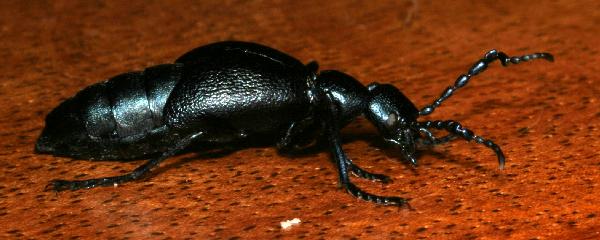
The one last fall was probably Meloe impressus. Aside from the time of year that it came out, this one also has little pock-marks on its back on the segment right behind the head, which I gather is an ID feature of M. angusticollis
“The cray is certainly not a fish, [but] a handsome crustaceous animal” – J. J. Audubon[1]
I’ve been meaning to make an entry for crayfish for some time, so when we went down to Otter Lake in the third weekend of May, we made a point of finding one. This one was resting on the boat launch ramp just above the Otter Lake dam, and we were able to just drop the net right over it.

Crayfish are pretty big as Michigan arthropods go. We put it in a glass pan with water for photography[2], and the squares on the checked tablecloth that you can see under it are just about a centimeter across, so it was just over 7 cm across from nose to tail (almost 3 inches)
Sam caught this jumping spider for me shortly after I finished the flash concentrator for the 2:1 macro lens combination. This made it possible for me to get some decent face shots that show its huge eyes and surprised expression[1]

There are two white stripes across the head, one under the eyes sort of like a moustache, and one across the top of the head.

Oh, the buzzin’ of the bees in the . . . wait a minute. Are those really bees?
We have a number of wild “choke-cherry” trees around the property which bloom pretty early in the spring, and back in the first week of May this one was in full bloom and was absolutely humming with bees. So, I went out with the camera to get some bee pictures[1]. Except, that upon closer examination, I saw that a large fraction of what were buzzing were not, in fact, bees!

The bee is one of our honeybees, but the other one is a bee-mimic fly.

As it turns out, Aesop was wrong[1]
Up until this year, I had been under the impression that grasshoppers all laid their eggs and died in the fall, like the fable says, and the eggs didn’t hatch out until spring. What a fool I was. Because on May 2[2], I found this fully-winged adult grasshopper jumping around in our lawn.
