
Our friend Seri was chainsawing some logs in our driveway yesterday[1], and she turned up these two beetles under the bark of a basswood log[2]. They were each about an inch long, and were initially stunned by the cold, although they got over it quickly enough.

Here’s another beetle with soft wing covers, that Sam caught in the house back on May 28, 2008. To make up for the nebulous identification of last week’s beetle (“some sort of soldier beetle”), this time I can be much more specific: it’s a Scarlet Malachite[1] Beetle, Malachius aeneus. Bug Guide actually has a list of characteristic features for this beetle, let’s see how it shapes up:
1. Black and red (black areas have greenish sheen in good light); elytra red with basal triangular black strip along inner margin, tapering to a point about two-thirds distance from base – Check
Back in June of 2007, I found two of these beetles mating on the cedar tree behind the house. As usual, though, they had disengaged before I could get a picture of them both together, and then the one that had been on top flew away and I lost it somewhere in the kitchen. This one was the one on the bottom, and so I expect it was the female:

I had to consult with the experts on this one. It is a good example of why a simple insect guide is not much good for identifying moths
So, on the 20th of May, 2007, I was tearing down an old outbuilding[1], and tore off a piece of wood-shake siding to find this underneath:

These are probably the single most common species of lady beetle in our area – the Multicolored Asian Lady Beetles, Harmonia axyridis[1]. The reason for the “multicolored” name is that their coloration is all over the place, ranging from lots of spots:

Back in the beginning of September, S_ and Sam were out for a walk in the woods when they found this clinging to the side of a tree:
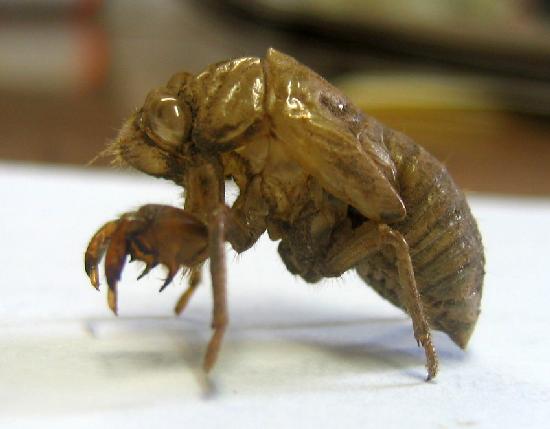
Tokyo must be destroyed!
It’s not the whole bug, it’s just the skin. There was originally a Cicada inside. As far as I’ve been able to find out, we only have one species of cicada in this area, the Dog Day Cicada, Tibicen canicularis. [1] These are the ones that make a screaming noise that sounds to me a lot like someone cutting sheet metal with a power saw. So, even though the nymph skins of all the cicadas look a lot alike, we can be pretty sure of the species of this one just because of when and where it was found.
Also known as “Barn Funnel Weavers”, “Sink Spiders” and “Those Monster Hairy Spiders That Run Like The Wind”.
OK, here’s one I’m sure you’ve all been waiting for[1]: the European House Spider, Tegenaria domestica.
Let’s start with the nice semi-action shot that Michelle [2] took in her apartment[3]:

These spiders tend to hang out in corners in our basement, just like everybody else’s basement.

They are “cellar spiders”[1], in the family Pholcidae. These in particular are probably Pholcus phalangioides, which is another of those cosmopolitan species that humans have carried all over the world. They are perfectly harmless, of course, but a lot of people get antsy about them because they are the sorts of spiders you are likely to find building webs under the bed. So, when a kid wakes up with some sort of “bites”, and the worried parent looks around the bed and finds a bunch of these hanging around, they are likely to get blamed for it, but honest, they didn’t do it (and, in fact, are quite likely to be catching and eating the fleas, bedbugs, or mosquitos that did do it).
Back in April, I had pictures of a caddisfly larva that we found in the little stream out back. Since then, I’d been wanting to get pictures of an adult too, but I wasn’t quite sure what time of year the local species emerged. Well, wonder no more: here are the adults, which started coming to our porch light right around the middle of October, and last I checked (November 14, after we’d had one significant snowfall) they were still around. They look a lot like moths, but aren’t.

Yesterday, K T Cat raised some good questions about the digestive system of insects, gnats in particular, so today I thought it would be good to talk about that. To start with, we need an example[1], so here is one: a larva that we found in Cole’s Creek in April:

Aquatic crane fly larva