
Lilacs are very popular in Michigan, to the point where I personally think they would have been a better choice for the state flower than the one we actually have[1]. They thrive in our moist, cold climate, have very few insect pests or diseases, and will grow with minimal care without becoming full-up invasive plants. They bloom here for most of the month of June, so I went out photographing them on June 14, 2019. We have several of our own bushes, some with the standard light purple blossoms, some with white blossoms, and some with deeper purple blossoms:

On June 22, 2019, Sandy was visiting our neighbors across the road, and they told her that they had some kind of caterpillar infestation on their azaleas. They have two azalea bushes, a large one with yellow and white blossoms;

I actually found this one back on January 23, 2019, crawling over the edge of our windowsill. She was pretty fast, so I only got the one picture. This one was uploaded full size, so you can click on it to see it bigger.

Sandy and Sam presented me with these fine morel specimens on May 26, 2019. They found them under some of the feral apple trees north of the house.

According to the pamphlet “May is Morel Month in Michigan” (MSU Cooperative Extension Service)[1], these appear to be the dark variety of Morchella angusticeps, which is the most common variety of morel here in the Upper Peninsula of Michigan. As you can see by comparing one with the size of my hand, these are around 3-4 inches long, definitely big enough to be worth picking.
This spider caught a fly near our kitchen sink (behind some potted plants) on December 27, 2018.
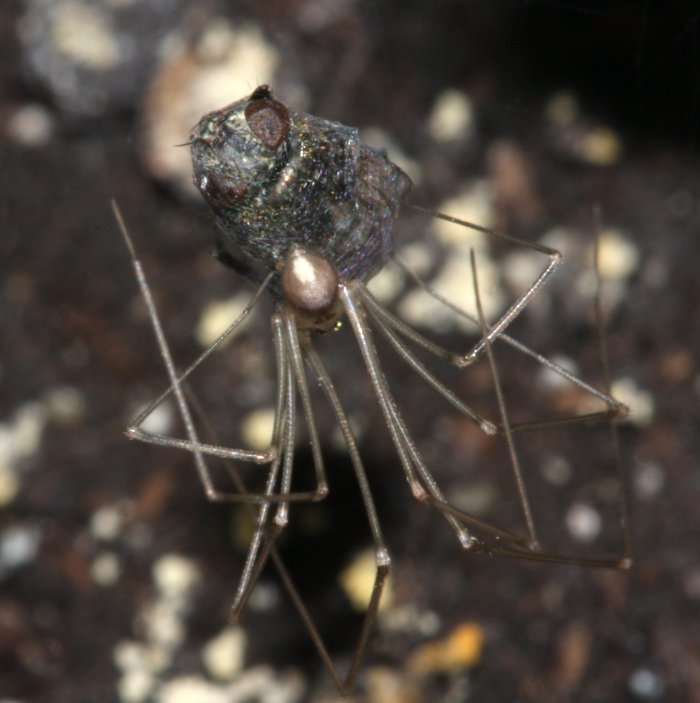
Neither of these is a new species for this site (the spider is a Cellar Spider, Pholcus phalangioides, and the fly looks like a Cluster fly, genus Pollenia). But, I haven’t shown one being eaten by the other before.
So, on Monday, June 3, 2019, I was just coming out of Swift’s Hardware downtown when I heard a duck quacking loudly somewhere nearby. So I looked around, and across the street I saw the two people who had come out of the hardware store just before me, watching a female mallard duck standing there making a fuss. So I crossed the street to see what was going on. By the time I got across the road, the reason for her fussing had appeared: her ducklings had caught up with her.

When I spotted this moth on the wall of the building I work in on May 24, 2019, I unfortunately only had my cellphone camera available. And since it was about the size of my thumbnail, the pictures didn’t come out quite as sharp as I would have liked. But anyway, here it is:

While I was pushing my bike up the hill on May 13, 2019, I almost stepped on this good sized black beetle. So I popped him in a plastic box and brought him home for pictures.
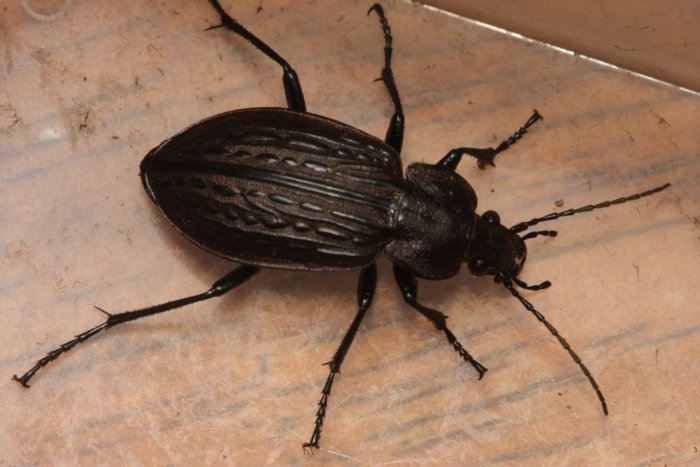
He was kind of a handsome beetle, black with brassy iridescent highlights, and large, glossy mandibles.
Sandy and I were walking in the pine woods behind the house on May 17, 2019 when we saw a number of these kind of lumpy, fungal masses:

They were pretty big and substantial, as you can see comparing this one to Sandy’s hand.
Here is one of the reasons why I haven’t been posting bug or plant pictures lately. As of May 1, 2019[1], it looked like this outside:

While that melted within a couple of days, it never really got warm. And as of today, (May 9), it looks like this: