
Ok, I just got back from snowshoeing in the woods today (April 7, 2019). The snow is still pretty deep [1], so it will be a while before I get much in the way of new critters or plants to photograph. But, the upper layer of snow has melted away to expose what is underneath. And much of what is underneath, is animal droppings.
These, for example, appear to be from a grouse.
On December 4, 2018, Dale took us to the Zuhl Museum at New Mexico State University. The Zuhls were dealers in mineral specimens, particularly petrified wood and other fossils, and they donated their extensive collection to NMSU in 2003.
The first thing you see at the museum is this giant petrified sequoia log outside the front entrance. Petrified wood figures heavily throughout the whole museum.

The Organ Pipe Mountains are just outside of Las Cruces, and Dale took us up there on December 2, 2018.

We didn’t get up into the mountains proper, but we did spend some time hiking around in the foothills. While doing this, we found this good-sized spider (her legspan was probably about the diameter of a quarter):
The previous two postings were creatures that we found on December 4, 2018 on our way hiking to and from the Prehistoric Trackways National Monument. So, today, let’s have a look at what we found when we actually got there.
This entire part of New Mexico was evidently a section of ocean floor that, during the Permian period, was gradually elevated to a shallow, swampy sea that was ultimately cut off from the ocean. It then dried up to form the local evaporite deposits during the Triassic period. As we hiked up the dry streambed to get to the trackways site, we were starting in older seabottom sediments, with characteristic oceanic fossils like these Brachiopod shells (not really clams, but similar),
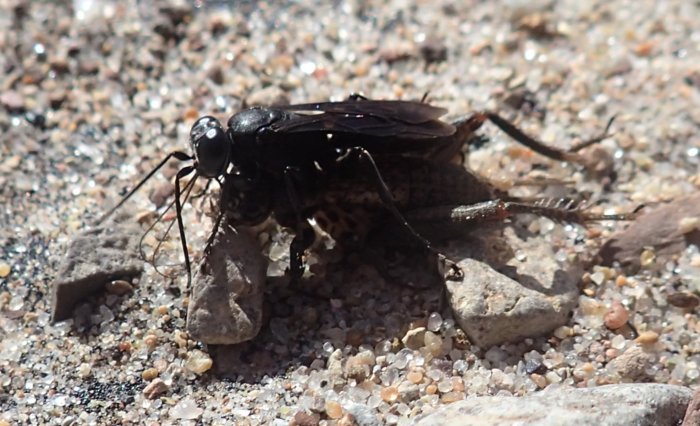
While heading up the Permian Trackway on December 4, 2018, there were a few interesting creatures that I only managed to get single good shots of. The best one was probably this Cricket Hunter wasp, with the paralyzed cricket that it had just caught and was carrying home to lay eggs on:
On December 4, 2018, Dale took us to see the Prehistoric Trackways National Monument, which is accessed by hiking a mile or so up a dry riverbed. While we were walking, Rosie and I had gotten quite a way ahead when we heard Sam yelling something faintly in the distance. So we turned around to see what was going on, until we could make out what Sam was saying: “I found a tarantula!”

One of the thing that struck us about New Mexico was the way that skeletons don’t disappear the way they do in Michigan. We are used to anything that dies being scarfed up immediately, with whatever remains after the scavengers finish being rapidly washed away by the rain or broken up by plant roots. But in the desert, once the food value has been extracted the bones are just left to bleach away in the sun.
For example, one of the first things we found while walking in the open area near Dale’s house was this skull, completely free of flesh. It appears to be a rabbit skull. I suppose that whatever ate it just didn’t want the head for some reason.
While we were looking for gypsum crystals on December 2, 2018, I first spotted this fairly large, thin, spindly-legged ant. It was about 60 degrees at the time, so the ant was moving reasonably slowly and I could get some decent pictures once I found a pose where I didn’t shade her from the sunlight.

Continuing down the slot canyon[1] in New Mexico on December 2, 2018, Sandy spotted something.

It was this great big nearly-wingless grasshopper, crawling up the canyon wall.

While we were visiting Dale in New Mexico, she introduced us to several of her favorite hiking spots. On December 2, 2018, she took us to a “slot canyon”, which is a deep, narrow canyon that is essentially a cave with no roof. Here is the entrance:
