
In the first week of December 2018[1], we took a family trip to visit a friend who moved to Las Cruces, New Mexico some years ago (Hi, Dale!) So, I would like to spend a few posts on the insects that we saw while there. We didn’t see a huge variety, but those we did see were quite different from what we are used to here in Michigan. Let’s start today on the various large black beetles that we saw, most of which were various types of Desert Stink Beetles.
This first one we found while looking for gypsum crystals, near Rincon, between Las Cruces and Hatch[2]. It was a big, slow-moving beetle, about an inch long and jet black.
Today, I wanted to talk a bit about (a) why ticks are such a festering mass of disease and pestilence, and (b) what you can do to avoid catching something from them.
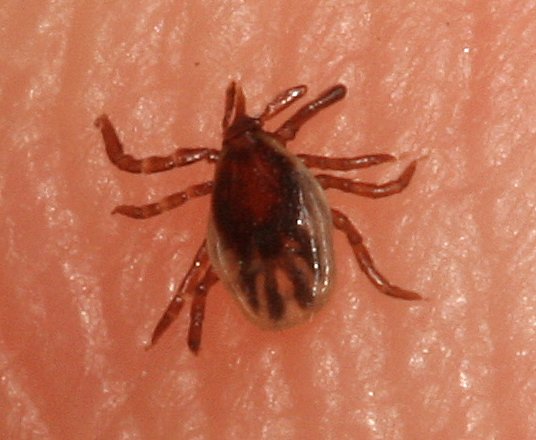
To start with, ticks are obligate blood-feeders. The have to get a blood meal for every growth stage, and in the process they ingest whatever horrible disease their victims might happen to have. So far, this isn’t too unusual. Lots of things like to suck blood, and would therefore pick up disease organisms. The thing that spreads the disease is if the blood-sucker bites more than one victim, which means they can pick it up from one and transfer it to the next.
Barklice (family Psocidae) are possibly one of the most Christmassy of insects. Why do I say that? Well, because they frequently are found in the house over Christmas, but not at other times. And there is a very good reason for that: they live in the types of trees that people like for Christmas trees. Here are some examples from just before last Christmas, December 24, 2017. They came into our house on the Balsam Fir that Sam and Sandy cut and brought in from our back yard.

We were driving home from Canada on June 27, 2018, and stopped for a bit at Au Train Beach. This is one of the Lake Superior beaches between Munising and Marquette, and is a spot where the bay is capturing a nice bit of sand. This is somewhat atypical for Lake Superior, which is more known for its rocky beaches (the more southerly Great Lakes are the ones with a lot of sand beaches).

Here’s one last thing I wanted to include from our trip to Montreal on June 25, 2018. While driving to town, I was looking at the city map we had picked up at the tourist information center, and I noticed that there was a huge greenspace right in the middle of the city. We were wondering why, with the rest of the city so built up and property values presumably high, such a large area had been left as a park. Then, after getting to the hotel, Rosie and I went up to the 11th floor (which was where the pool was located), and I looked out of the windows.
Oh. That’s why . . .
When we visited the Montreal Botanical Gardens on June 25, 2018, we saw that it included an Insectarium[1]. So, of course, we had to go there, right?
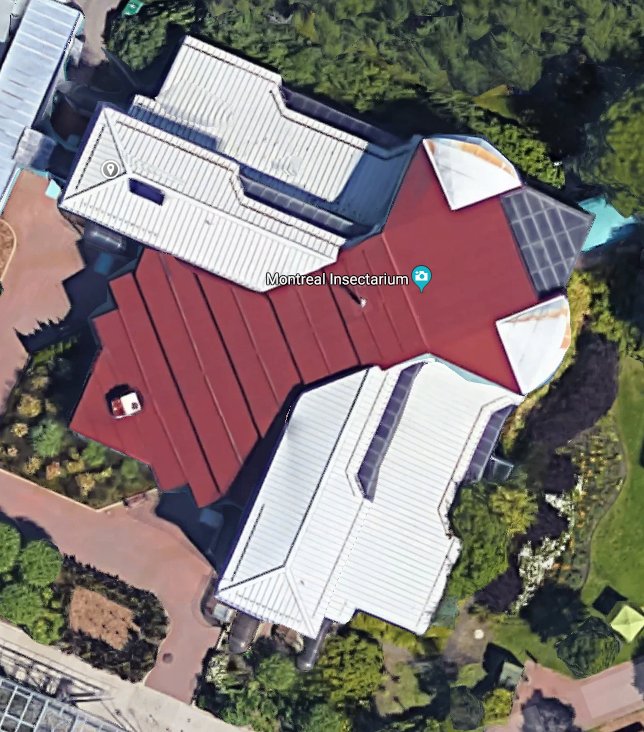
Right. Here’s an aerial shot of the Insectarium that I grabbed from Google Maps. You may note that it is shaped like a stylized insect: the head and eyes are facing to the right, the reddish-brown part of the building is the body, and the white wings on either side are, well, the wings:
When we arrived in Montreal on June 25, 2018, we found out about the Montreal Botanical Gardens. We hadn’t been aware of this until we got into town, but this is possibly the most extensive botanical garden in North America. It was only about 20 minutes to get there from our hotel using the subway system, so of course we had to go.
The entrance is a park all by itself, with fountains and artificial streams.
Continuing with the plants at the Riverbend Campground on June 23, 2018, we saw significant areas covered by this low plant with a great profusion of yellow 5-petaled flowers.

These are definitely a variety of Sedum, and are most likely Biting Stonecrop, Sedum Acre.
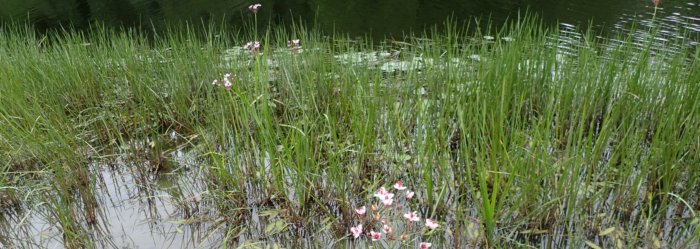
Remember the bullfrog pictures from Canada that I took on June 23, 2018, and that I posted a few weeks ago? Well, here are the plants that the frogs were hiding in. These are rushes that grow on the riverbank, out to where the water is maybe a foot or so deep.
Cone-shaped terrestrial snail from Ontario
While we were at the Riverbend Campground on June 24, 2018, I was strolling around and spotted this little snail crawling along the edge of a leaf.
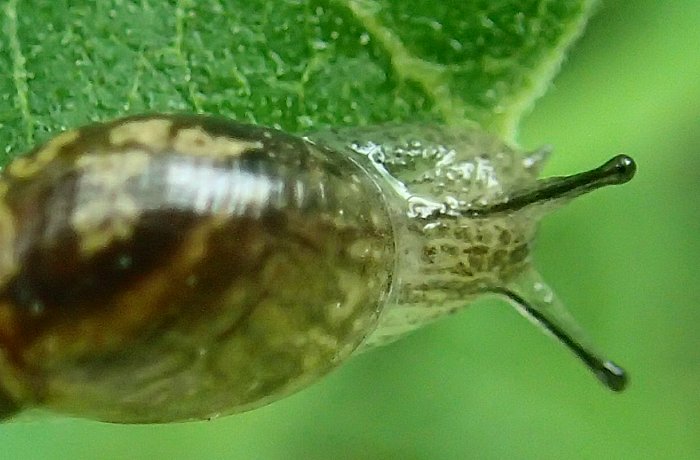
You can clearly see its eyestalks, including the dark optic nerve running up them. I understand that snail eyesight isn’t so hot, but they do have the advantage that the stalks allow them to peek around the edge of their shells.