
This small brown moth (a bit bigger than my fingernail) came to our porch light on June 25, 2016.

The way that it holds its abdomen tip curled to point straight up makes me think that it was spreading scent to attract a mate, which in turn suggests that it is a female[1].
This vine was growing across the boardwalk at the Pilgrim River Preserve on June 6, 2016.

It had fairly distinctive leaves, with two elongated lobes at the base.
Sandy was petting the dog on June 27, 2016, and felt a tiny object on the dog’s skin that didn’t feel quite like part of the dog. So, she got our Tick Twister tool, and pulled off the object. Which turned out to have legs.

Our second flower found beside the Pilgrim River on June 26, 2016 is this odd-looking specimen:

It almost doesn’t look like a flower. The maroon petals[1] are kind of rough and husk-like, and the center almost looks as if the fruit had already been picked. But, it was clearly producing pollen, and it was early enough in the season that we can be pretty sure it didn’t have time to get beyond the blooming stage. The flowers weren’t too large, as you can see by comparing them with my fingers.
Black and White Spotted Moth with Orange Shoulders – Small Magpie
This attractive little moth was hanging around our front door on the morning of July 3, 2016.
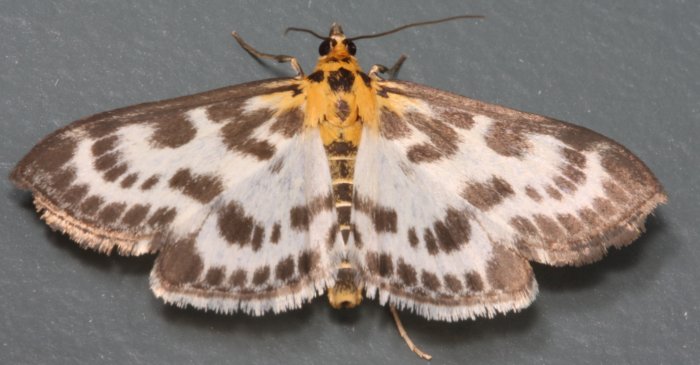
From the rear, we can also see that the abdomen tip is orange, and it has the little fringe of hairs along the wing edge that we’ve seen in a lot of other moths.
June 26, 2016 was a beautiful day, so we took the kids and Granny down to the Nara Nature Trail, which runs alongside the wetlands at the mouth of the Pilgrim River, just east of town[1]. The first photo-worthy plant[2] that we saw was this clump of blue irises:

We were up at an annual gathering with friends on the old stamp sands near Eagle Harbor on July 30, 2016, where I was informed that a large spider had been spotted. This spider, in fact:

I unfortunately didn’t get a good size reference in the picture, but if I had gotten it into my hand, I think the legs would have stretched most of the width of my palm. And, it was a fairly uniform creamy-white color, which is unusual in a spider.
While biking to work on July 27, 2016, I spotted these vibrantly purple flowers growing beside the ditch alongside the road:

While it is a rather pretty flower, I would like to call your attention to one alarming fact: It is growing in immediate competition with Tansy, one of our most aggressively invasive species. And it is thriving.
Sam and Rosie spotted this beetle on the wall of our front hallway on May 7, 2016. It’s a Scarlet Malachite Beetle, Malachius aeneus.
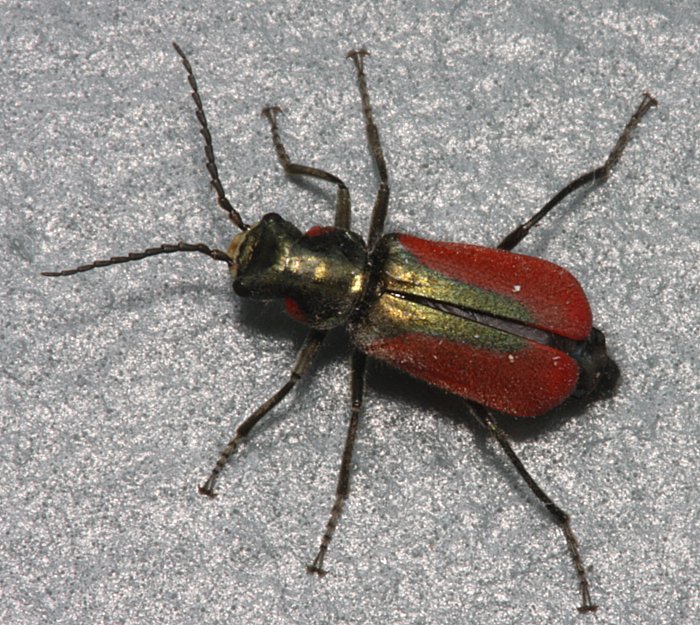
I didn’t originally plan to post this species again, seeing as how I have shown it on this site three times before, but come on, it was right there, practically posing for me.
On August 27, 2016, Sandy came back from a walk down the hill, and told us that she’d found a ripe giant puffball in the woods. So, the girls and I went down and retrieved it. Here it is:

This is basically a giant spore-bag. The interior is just a massive ball of dust.