
While I was bicycling home on June 20, 2016, I saw this large and excellent spider hanging out on the handlebars. It liked to rest with its legs stretched out in a line, which on a plant stalk or tree trunk would have made it really hard to spot.

On May 8, 2016, Sandy and the girls went back to the swamp in the woods to see what they could catch. They caught this:
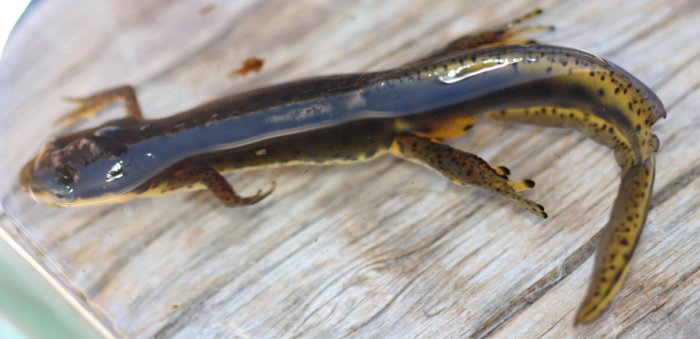
It’s an Eastern Newt[1], Notophthalmus viridescens. This one also has a “friend”, I think that’s a mayfly nymph on its head. Newts eat insects (among other small creatures), so this may be more a case of the nymph hiding in the one place where the newt can’t get at it to eat it. The old problem of once you start riding a tiger, how do you get off?
Sam found this on a windowsill on June 11, 2016. It was a little fellow, the body was not much more than an eighth of an inch, and even with the long legs I think it would have sat on a penny with plenty of room to spare.

These plants are one of the signature species in the area, and figure heavily in the tourist trade – Thimbleberries, Rubus parviflorus. They are primarily a cool-weather western species, growing along the west coast at increasingly higher altitudes as one moves south. They mostly don’t grow east of the Rockies, but somehow we ended up with a disconnected population along the southern and western shores of Lake Superior[1]. They grow quite lushly, particularly on the north side of roads, alongside woodland trails, and at the edge of wooded areas. Here’s a patch on June 13, 2016, right at the height of their blooming season:

On June 7, 2016, Sam found this between the brick pavers that make up our front porch. It was about half an inch long (roughly the same size as an earwig).

Its most distinctive feature was the yellow tail. At first I thought it might be a female firefly, because some fireflies have wingless females, and the tail tip was sometimes dark,
So, last time while talking about Baltimore Checkerspot butterflies, I mentioned that their caterpillars have taken a liking to English Plantain, a common invasive weed. How common is it? Well, it makes up a substantial fraction of our lawn, for one thing. Here is some that I photographed on July 2, 2016, right in their peak blooming period. The flower heads are the most noticeable, they shoot up to about 6 inches tall and look like this:

I found this spiky orange-and-black caterpillar crawling across the road on May 31, 2016. It was about an inch long, so not too huge as caterpillars go.

Those spikes are similar to what I’ve seen in several other butterflies, most notably the fritillaries and mourning cloaks, so I figured it was related to them.
During my walk in the woods on November 8, 2015, there were some late-season fungi growing out if the sides of pine logs. They were not too large, this one was only a couple of inches across (that’s a stalk of grass running across the top of the picture, if you’d like a sense of scale).

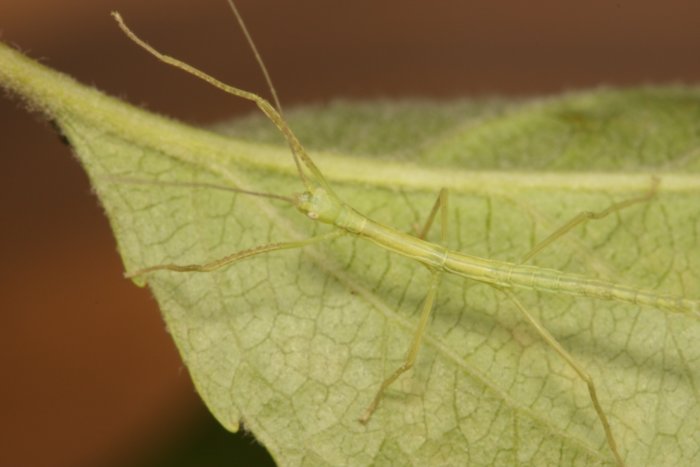
On June 19, 2016, after a night of camping in Traverse City, Sam told me that Rosie had found an interesting insect crawling on their tent on the mesh under the rain fly. “I think it’s a stick insect”, she said. And, she was right. It was a stick insect!
These were very plentiful at the east end of our lawn on May 26, 2016. The spot with the greatest number is a nutrient-poor area with shallow topsoil that floods during the spring melt, but then dries up to the point where it barely even supports grass.
